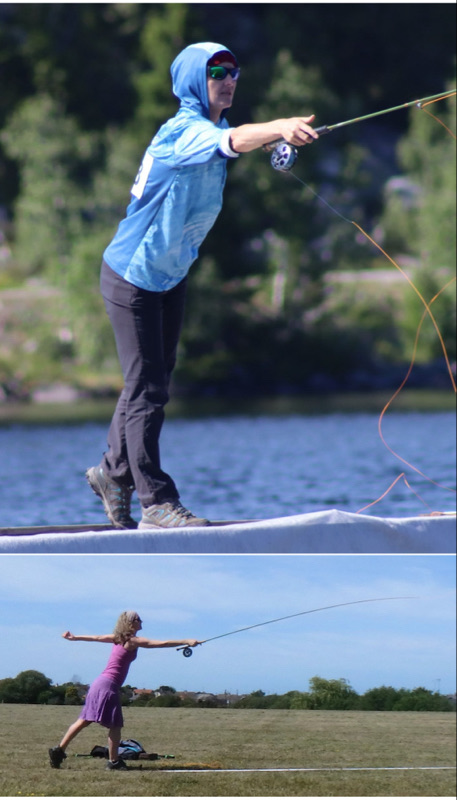
Tracy&James | Sunday, 23 June 2024
As I write Tracy and I have just come back in after some last minute practice for the first BFCC competition of the year. Actually it should have been the second BFCC day but the first had to be cancelled due to a waterlogged pitch. As you're reading this we should hopefully be in Kent competing in the seven events that make up the championship. The forecast is for a very pleasant day weather-wise, although the light winds predicted will be good for the instructors and their clients rather than the competitors, who would much prefer a steady, strong wind.
I've been working with Tracy lately to change her forward cast; she's an axe-thrower by default rather than a fencer. By 'axe throwing' I mean that her forward stroke tends to rotate downwards at the end, a bit like the action someone would use to throw an axe in an end-over-end tumbling motion at a target. Although this is perfect for choppers, it tends to place the rod-leg of a fly cast too low for when the object of the exercise is distance.
Now axe throwing may work for some, in fact Paul suggests drawing a line down through the target in his description of a '170' distance cast, however for me this gives the fly leg some extra work to do in morphing the forward cast tight. I have no issue rotating the tip well past the target trajectory on the backcast and allowing a 'bouncing bomb' type morphing to happen, but this is on a fixed carry and the rod-leg tension is higher due to the fact that line isn't being shot. This is not the case with the forward cast delivery where the rod-leg tension is much lower due to the caster having let go of the line. With this preference, I've been working with Tracy to get a thrusting, fencing type finish to the forward cast.
I've tried various analogies like pretending Robert Pershing Wadlow is stood in front of her and she wants to poke him in the eye with the rod tip. I've got nothing against Robert by the way, I'm sure he was a really nice guy, all eight foot eleven inches of him. Actually, he would maybe have made a great fly caster himself – imagine launching from that height and having an eight foot plus haul! Then again he was pretty much crippled by the overactive pituitary gland that was pumping him full of growth hormone right to the point of his sadly early death at age 22.
Away from assaulting giants, I've been asking Tracy to perform a number of off-the-ground casts with a shooting head. These are started in slow motion until the hands are in the position to haul apart, with the rod hand stabbing upwards. (I should say here that this can produce some spectacular tailing loops unless the lead up is smooth and accelerating). One thing I have found is that by lengthening or shortening the overhang the caster gets some feedback regarding the haul timing. On a short overhang the backing knot impacts the tip ring (juddering the cast) when the haul has moved just a short distance, thus the caster can feel if they've started early. As another aside, I think axe-throwing (or certainly in Tracy's case) is a symptom of going too early with the power application – a very common problem with people wanting to increase their distance. By lengthening the overhang to a fraction shorter than the total hauling distance, Tracy gets some instant feedback as to the timing of the end of her haul and confirmation that she hauled it all the way.
What was very pleasing after these exercises was that Tracy hit a personal best with the ST27 outfit on a day when normally a PB wouldn't be on the cards, i.e. in just a moderate breeze that meant we were using our mid-length head rather than the shortest one which gives the biggest distance in the strongest winds. I was watching Tracy's cast from the side and I've never seen her throw such a high (in terms of where the rod-leg was placed), fast loop before. I pretty much called it as a PB before it landed. I also know there's more to come when the wind is strong enough to call for the short head to be used.
Hopefully Tracy will be fencing rather than axe throwing today – we'll see.
Have a great week.
James