Rickard Gustafsson | Saturday, 24 January 2026
In fly casting we stop fly rods. We are not getting away from that, even with a stopless technique. The rod has to stop sometime and we seldom let the ground stop the rod. I’m not a huge fan of the “hard stop”, I think it causes more problems and confusion in most of the cases. The good stuff happens before the hard stop. I have also found another reason why the hard stop is bad and that I have been a bit wrong in a previous FP and missed something important in the FPs about elbow pain.
I thought for a while that my elbow pain was in a quite good place. That it was as good as gone with some minor flair ups from time to time. I was wrong, I have made quite big progress in the last days actually. I would like to describe the feeling as my arm is quiet. It is just wonderful. It isn’t perfect but it is quiet, I just couldn’t tell before as I had gotten used to the previous noise level. That noise level drowned some of the pain I can tell now as I’m in a better state. Like sitting in a room and the ventilation suddenly turns off, then you suddenly becomes very aware that the ventilation was very noisy.
The things I’ve suggested for working on elbow pain from casting before is still good, useful and needed to take care of the problem.
But it seems like I was a bit wrong in this FP: https://www.sexyloops.com/index.php/ps/one-exercise-to-take-care-of-it-all
The biceps isn’t the only brake. What I’ve learned is that triceps takes a big role in the braking of the arm, something that I still have a hard time to understad. How a muscle responsible for extending the arm can also stop it from extending? Biceps is a brake for velocity here and triceps works for stability. As I have understood it triceps is actually the primary protector here.
It started by that I noticed that my triceps felt stiff when I touched it, like this cannot be good other relaxed muscles doesn’t feel like this. I started to research a bit what I could do to make it a bit more relaxed and this lead me into if it could be related to the pain I’ve been having in/below my elbow. That’s how I learned that the triceps is involved in the braking of the arm. And as I haven’t found any good sources for fly casting how the triceps work I have looked at baseball pitching and javelin throwing. It isn’t a simple thing as there are multiple reasons why the triceps causes pain below the elbow.
So let’s have a look at the work the triceps has to in the cast. The fact that we don’t release the rod increases the work the triceps has to do during the stop. A lot of the kinetic energy we have built up is left in the rod so it isn’t just the arm the triceps is stopping. The triceps has to shift from a concentric push, to an eccentric brake ending in a high tension isometric hold.
The Eccentric Load, The “Braking” Phase
This is the momentum where the physics can feel like a contradiction. The triceps, the muscle responsible for extending the arm, is also the muscle to stop it.
As you accelerate the rod forward, the triceps works concentrically, it shortens to extend the elbow. As we stop the arm we just don’t let the arm go limp, some tension in the arm is needed to stop the rod. To do this the triceps must immediately switch roles. It doesn’t stop working, it stops shortening.
The triceps suddenly “clamps down” on the elbow joint to create instant stiffness. Because the rod and the forearm is still trying to pull the arm forward, the triceps fibers are actually being forced to lengthen while they stay contracted. This is an eccentric contraction.
Because eccentric loads involve fighting against momentum, they are the most taxing movements for muscle tissue. If the triceps cannot absorb all the energy that needs to be stopped the left over energy has to go somewhere. It spills over, bypasses the triceps, and slams down into the elbow joint and the forearm extensors. Here we can see the downstream effect of pain starting to form. And also can see why the triceps become stiff. A muscle that cannot handle all the work it is being requested to becomes stiff to protect itself.
The Isometric Load , The “Fixation” Phase
Once the rod has been stopped the triceps works static in an isometric hold to let the rod unbend. The rod creates a rebound force that wants to jerk the rod forward. This puts a demand to keep the triceps in a high tension isometric contraction.
This is my attempt to explain the work the triceps is doing for us. It is very simplified. This is the braking it does. It performs more work it is a dynamic stabiliser of the elbow, it even prevents over extension of the elbow. It works in shoulder stabilisation, the long head of the triceps passes the shoulder joint and works together with the rotator cuff and lats to keep the humerus in its socket. And from there the lower trapezius and the rhomboids keep supports the shoulder blade and the rotator cuff. It is all connected. But now I will focus on how the triceps gets us in trouble/pain.
Why The Triceps Causes Forearm Pain
If the triceps cannot handle all of the energy overflow we have to take care of. By being fatigued or lacking strength to do it or poor movement mechanics energy will flow down into the forearm. This causes more load on the extensors in the forearm. It seems like we can compensate a weak triceps stop by over gripping the rod. So a too tight grip can be both the cause of pain from casting and a symptom of something else in the cast. Bringing a lot of work to the brachioradialis and the other extensors in the forearm, located 5-10 centimeters below the elbow. The braking conflict between the triceps and the muscles in the forearm and/or the over gripping puts a lot of strain and can cause inflammation in these muscles. That alone is a big reason we get elbow pain from casting.
If the triceps is over worked or cannot work efficiently by poor movement mechanics it will protect it self by becoming stiff and knotted full of trigger points, especially in the lateral head. From here we get referred pain in the upper part of the forearm.
Just by braking the triceps sends energy down the forearm also. The triceps tendon is continuous with the deep posterior fascia of the arm with fascial connections to the lateral forearm. Where the forearm extensors works on stabilising the hand also. The forearm extensors have a high tendon proportion, relatively poor blood flow and have a higher density of pain receptors. This also explains why the pain is first experienced here.
Both the stiff and knotted triceps and strained and/or inflamed forearm extensors irritate/entrap the radial nerve. The radial nerve passes directly underneath the triceps and through the forearm extensors in the painful area (the radial tunnel, thats why it’s called radial tunnel syndrome). An entrapped radial nerve will manifest as a burning or aching pain 5-10 centimeters below the elbow. And this is where the pain manifests even if the entrapment is in the triceps area.
The 90 degree stop can probably put extra strain on the radial nerve as this seems to be the most vulnerable position for the radial nerve.
Could it be tennis elbow
Yes it could also be. And it seems like tennis elbow can happen for at least two reasons. By not treating the things mentioned above the extensors in the forearm can work too statically and cause tendinopathy, tennis elbow. A too tight grip by gripping the rod too hard or trying to keep the wrist fixated then we get a lot of static work in the extensors in the forearm. So could it be that cue keep the wrist stiff is causing more problems than we have thought of before? Probably as trying to keep the wrist tiff and a death grip goes hand in hand. Trying to keep the wrist stiff enforces a death grip. And with a stiff wrist the shock from stopping the rod has nowhere to go and has to go back into the lateral epicondyle.
What can we do?
If you experience pain in the elbow from fly casting you will probably not rest it away. You want to do the things I’ve written about before, the radial nerve glides, the rotational exercise and the eccentric load for the extensors in the forearm. On the eccentric load exercise I have some good news for you, you can probably back off on the intensity and focus more on control. You can read more about it here:
https://www.sexyloops.com/index.php/ps/fly-casting-elbow-exercises
https://www.sexyloops.com/index.php/ps/sticky-nerves
What you want to add is triceps care to get it to work better and in first case relax.
Massage your triceps either with your other hand or better with a lacrosse ball or similar. Search the triceps for trigger points, hot spots. Put some pressure on the spots, some minor pain but not high on the pain scale. Then you do controlled contractions and extensions of the elbow while keeping the pressure on the hot spot. 5-8 slow and controlled repetitions. Work on 2-3 areas per session.
Train the triceps eccentrically with a light weight. The focus here is to show the body that we can control the movement. We want to use an exercise where the long head of the triceps is worked, like a standing triceps extension. Using a light weight focusing on control in the eccentric part of the movement use both hands to raise the resistance and one hand to lower the resistance. Perform 2 sets of 6-8 repetitions per session.
Doing this you should soon feel that the tension in the lateral head of the triceps disappears and a reduction of pain in your forearm.
What is good mechanics?
If I can say that bad mechanics is a reason for the pain then I must know what good mechanics are? No not really but I have some ideas.
Avoid a stiff wrist. Keep the hand relaxed. As we squeeze to a stop the hand must also relax. Help the rod dampen, while not taking up unnecessary vibration in the arm.
In a pull-back, you are asking the triceps to perform an explosive stop and then immediately reverse direction. This doubles the eccentric load and requires the radial nerve to 'slide' back and forth under high tension.
Doing accuracy hovering, especially with a pull-back stroke, is more taxing than we might think.
I think John shares an important thing there: https://www.sexyloops.co.uk/theboard/viewtopic.php?t=2143&start=40#p56331
“If I may make a suggestion don't allow your elbow to move inside your wrist and hence, away from that stable and powerful position Paul has illustrated.”
I think the something is being illustrated here: http://www.youtube.com/watch?v=xlIuMUF1hcQ
Good mechanics for us are similar but not totally the same as other pitching/throwing sports as we don’t let go of a big part of the load we are moving.
Because we don’t release the load, the triceps becomes the final shock absorber of the system. If it is too fatigued or too stiff to perform that role, the load is inevitably transferred to the elbow and forearm.
Cheers, Rickard
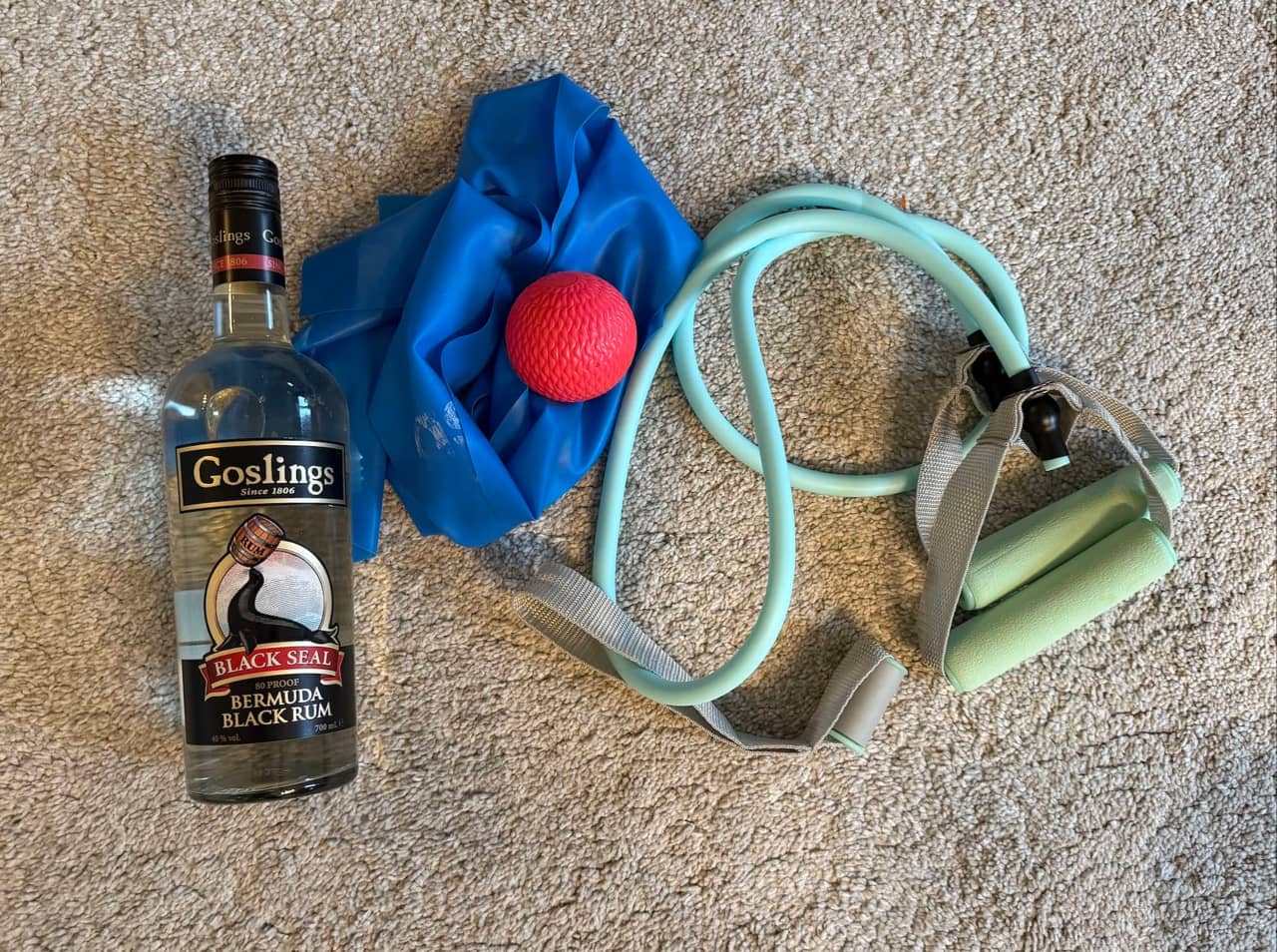
PoD: Your new best friends if you have elbow pain.