Martyn White | Thursday, 16 April 2026
If you read these regularly, you'll maybe have noticed that I strongly prefer deer hair for my topwater bass bugs. I'm absolutely convinced it's the best choice for most freshwater situations.
In saltwater however, I don't think the advantages of hair are really there. Foam is where it's at, either hard polystyrene/Styrofoam or HD closed cell. There are plenty of pre-made poppers available or you can shape your own with just a Dremel tool and a razor blade. Making your own obviously gives you more flexibility with size and shape. Maybe there's some argument about it being less consistent than mass produced jobs but if you buy a few packets of pre-made heads you'll quickly realise that consistency and quality control might not be the first consideration in their manufacture... I don't think I've ever had a pack of wapsi perfect poppers that hasn't had at least one unusable head! In recent(ish) years there have been a few new head shapes coming out: double barrels, howitzers etc. They're fine, but I haven't found them to be any more effective than a normal cup faced popper.
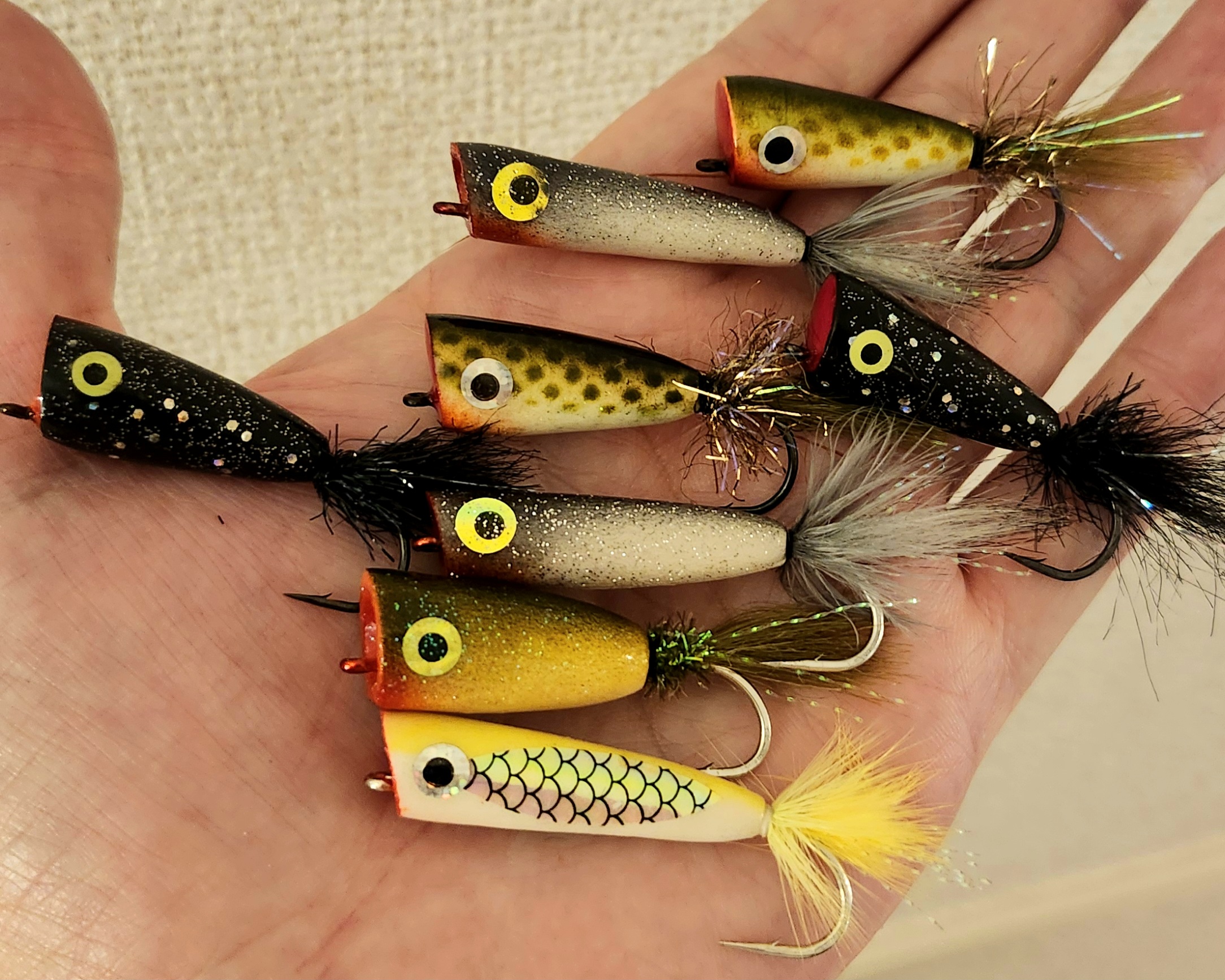
If you are like Paul, you can just glue a head to a hook lash on a tail and you'll have a perfectly fishable fly. Or you could go the other way and finish them with all kinds of fancy finishes. That is satisfying but also a bit chore at times. I'd imagine most people are somewhere in the middle, maybe a bit of colour from a pen and a stick on eye. The only thing I really think is important is a red face. Not as many think for the fish, but so I can tell the popper is facing me and there’s no/little slack in the line before I bloop it. I'm not fussy about tail materials, some kind of hair or synthetic is usually fine, maybe a bit of flash.
There are some things you do want to consider when making foam poppers though.
Glues
All heads, both slotted and bored through need to be stuck to the hook somehow and most people online seem to recommend superglue/CA which isn’t really ideal.
For softer foam you can get away with CA glues, but generally they’re not saltwater safe. Probably fine in open water but if you are anticipating using the flies where you might hit something like a mangrove or a dock, it’s not a good idea. Unless you put a strong topcoat on the fly you’re going to end up losing or at least loosening the heads from your poppers both of which render the fly useless.
For hard foam epoxy is the best option. It’s strong and durable, if you lose the head it’s generally because the foam has broken. With soft slotted heads you will need some way of holding the foam closed which is a bit of a pain, the best solution I’ve found is to wrap it in masking tape and rubber bands,.
If the hook is fitted through the head, epoxy is the best option regardless of the type of foam.
Colour options
Pens are obviously the quickest, but most won’t mark well on areas where CA has touched, and they often don’t last well. Copic, despite being popular and pushed by a lot of fly shops will ALWAYS wash off your fly unless it’s protected by a clear coat. One advantage is that if you’ve put a base coat or foil on the body you can wipe off mistakes with an alcohol wipe easily. Sharpies probably offer the best range of colours and the best indelibility.
Nail polish is a cheap, quick alternative to paints and will work with most base coats and foams, the only issue is that some clear coats don’t like nail polish so need a clear barrier coat- I’d rather avoid that if possible because it takes time and adds weight.
Acrylic paints and paint markers are good and will play nicely with most other colours and finishes, I like to put a pearly white acrylic coat down as a base on most of mine as it covers slots and looks better that plain white. If using acrylic paints fo the rest of the colour you have a huge range of colours and opacity, it can be sponged, brushed, airbrushed or sprayed on the fly. I also find that acrylic paint works better than anything else I’ve tried when using stencils.
Topcoats
In my opinion there are only 2 worthwhile choices, urethane and epoxy.
A clear urethane like Liquid Fusion is ideal if you want to avoid adding weight and just protect colours added with markers. I like to thin it with water which lets you get a lighter coat that dries a bit quicker. Also, it won’t whiten when wet as can occasionally happen when a fly coated with un-thinned Liquid Fusion is put in away without being totally dry. Gorilla Glue is also a urethane finish but can’t be thinned or cleaned up with water, though it does produce a nice finish that won’t whiten. While these wont really be much tougher than foam when it comes to toothy fish, the will give you a fly that will bounce without cracking so they’re a good choice if you’re fishing near hard structure and need to put the fly close.
Slow curing, 2-part Epoxy is great for a tough clear finish and is definitely handy if you’re targeting toothy fish. Don’t use 5-minute stuff for a topcoat, it will yellow pretty quickly, sometimes in just a day of fishing (an issue many of us will remember with pre-UV resin surf candies). Slow curing epoxies will stay clear for years, I have some that I tied before the pandemic and they’re still perfectly white. The longer the cure the better really, I use a lure coating epoxy I buy here in Japan that’s like flex-coat. It has a 90-minute work time and needs 12 hours to fully cure. Don’t let the long curing time put you off, even if it’s just a 20-minute or 1-hour cure you need to use a drying wheel, there’s no meaningful increase in working time on your part. You might want to check after a couple of hours and flick the flies with a lighter an extra time to free any bubbles, but this is still less time than you need mixing multiple batches of quick curing epoxy that still need at least one going over with the lighter before going on the wheel. With long cures the finish is great, and even when applied quite thinly is tough and fairly tooth proof. You can add glitter flakes or pigment powders to epoxies and it looks nice, probably doesn’t matter to the fish but if you like it, you like it. Also the epoxy top coat really helps to keep the fly together and really makes a big difference if you’ve gone down the superglue route when attaching the head.
As I mentioned earlier, the amount of work you put in is entirely down to you. I like making daft fancy jobs, but if I’m using a lot of them in a short time, I’ll pretty quickly abandon all the nicety and just glue the heads on, hit the face with a red pen, maybe I’ll give them a clearcoat if time allows.