
Chris Avery | Wednesday, 3 January 2024
Oh how I’ve tried to run the logical order of events, but it’s not always easy. As, of the various spheres of activity that seem unrelated, but then interact and you realise that events must have been earlier or later. It’s either such a tangled web we weave etc, or I’m just getting plain dotty.
One such event is Simon Johnston who was the head of the Wild Trout Trust at the time, he came along to demonstrate cleaning gravels, he made an off -cuff remark that confirmed my doubts and changed my relationship with the hatchery box. Now I realise it was just after the second winter of buying in the eyed Ova for our next attempt. Earlier than I thought.
Following that first batch of successful hatchlings as the box was tidied away and the volunteers got to exchange notes, four issues seemed very evident.
-As the gravel was removed to rinse it and clean out the substrate box, the build up of silt was a stinky sludge that caked the lower level and was depressingly higher up the tank than we even feared. Quite obviously that daily wafting with a piece of wood was not sufficient to shift through that slit, we needed to arrest it before it got in, but without compromising the velocity of flow that we could achieve through the pipes. A more efficient header filter in the stream wouldn’t do it.
There were also a good number of hatchlings held back, seeming reluctant to leave the hatchery box despite the yuk and the squalor, typical bloody squatters!
In summer flows when the Brook tends to run clear, the design may have coped with that, but the higher waters of our potentially muddy drain, always carried so much silt as it flowed high, looking like a river of discarded cappuccino.
So, a primary box was planned for the following winter full of long snake like brushes to arrest the particles These could then be rinsed clean daily with bitterly cold hands in the biting cold water, Oh deep joy. And I had volunteered to do an extra shift a week!
-Then there were the discussions of where people had put the fry and of the scarcity of water suitable.
The obvious quick fix of silt traps in the margins would not help immediately as the hatchlings require a more solid surface below them. We actively tried to create and promote more suitable areas and create more awareness. My personal campaign was to look at the Shallow part of the stream that we ran the overflow into, and I set about finding slow shallow drifts in there and preparing them ready for seeding hatchlings along the banks, that had to be good for a few hundred more at least.
But was also looking at planting irises in the margins elsewhere, in areas that I had no intention of using egg box hatchlings, but would increasingly benefit the stream bred Trout in time, I was in fry habitat focus and mode.
-The chairman was becoming increasingly difficult to deal with, as he seemed to have personally invested into this, as a vanity project for is garden and property unsuited to parr and juvenile trout and was increasingly belligerent to suggestions leading it away from that.
He needed another project I felt, more suited to his skill set as an architect.
-And then there was something amiss with those fish coming out of the hatchery, the early flushes in the catch box, were textbook hatchlings skinny little match sticks with a small obvious pink little egg sack remaining suspended from their chests. The later ones were more developed. Like in the photo last week they were more rounded but with less egg sack remaining if any. To my mind this was wrong.
Some people guessed that it was good. Claimed that these were obviously more robust individuals, ready to take on the world, dominate and thrive. But nature doesn’t agree with this, if you look back to what happens in the stream ,in that ideal model that we are attempting to replicate somewhat imperfectly.
(Allevare sounds like a French car model, the Citreon Allevare coupe!, ‘Allevare’ is however, the Latin word for ‘raise up’)
A Trout or Salmon egg that hatches in the gravel becomes a tiny Alevin, a fish with a reserve sac of yolk to ‘raise it up’ through its next stage of life while gaining in strength and size.
It needs to stay safe and out of the flow, so nature makes its eyes oversensitive to the light and like a teenager in its bedroom it buries deeper, away into the darkness. As the foods absorbed and it grows, it prepares for the next stage of life by gravitating to the edge of the stream, still sulking under cover, wriggling through the gaps between the gravel, remaining safely under the streambed. Gradually its eyes lose their aversion to light and gain a new abhorrence, this time for the avoidance of other small Trout.
Think of that teenager analogy again and now add the voice of Morrisey or Niel from the Young ones. ”Oh No! Do I really have to go outside, those other Trout are so revolting, I hate everybody”
On the sight of another Trout on the stream bed, it will stiffen up, spread out its fins, open its mouth and flare out its gills, and this half inch semi translucent streak of slime with two silly big eyeballs and a dopey expression will become as terrifyingly threatening as it can possibly manage.
The smaller, weaker, more scared of the two drifts downstream to settle in another spot where it doesn’t have to eyeball a rival, or, finds it is the bigger of the two and now can stare out and dislodge its smaller rival.
This system of shuffling the available territory affords these tiny Morrisey’s the space to forage enough food to sustain, and to hopefully grow.
This sets the pattern for life’s encounters with other Trout over the best feeding areas and territories, a kind of non-violent aggression. Though the expense of losing these encounters may well be an avoidance from physical harm, but it often it leads to less productive feeding stations, demise and then death.
In a spot where the velocity of the water flow is anything from virtually static to a flow of around just a foot ( 30cm) a second (pretty damn slow in most streams). With a depth of water from a few centimetres up to a maximum of a foot (shin deep). Our hatchling Morrisey’s will settle down on a non-silty base ready to quiff up if necessary. Down In the minimum of current with its pectoral fins spread touching the bed for stability watching for small parcels of food passing over head.
It must then lift up in the current to time the encounter with that moving morsel and then return to its place on the stream bed. Learning the technique of feeding and preserving energy in moving water.
If the energy gained from that morsel is only equivalent to the energy spent in its attempts to lift through the current and back again and holding station, then it relies on the energy remaining in the last of the yolk to buy some time until it learns to perfect these techniques... When it no longer has that remaining egg sac reserve, it either gains and grows, or it dies.
This is the point where the huge mortality rate kicks in and sorts out the survivors, and less than 5% leaving the gravel expect to pull through this stage of development and making it to become a parr moving to slightly faster deeper, food abundant, flows.
So, those late developers we put in the stream had to find a territory, may have to go through some stroppy conflicts and displacements, than learn to eat profitably with seemingly no reserve on board, no margin for error, to avoid being one of the 95%.
So why was this happening to our alevins developing into hatchlings too early, or coming out late?
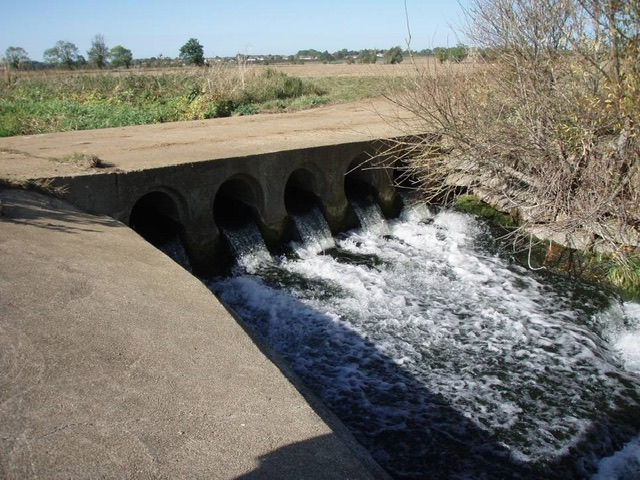
(the culvert bridge looking benign)
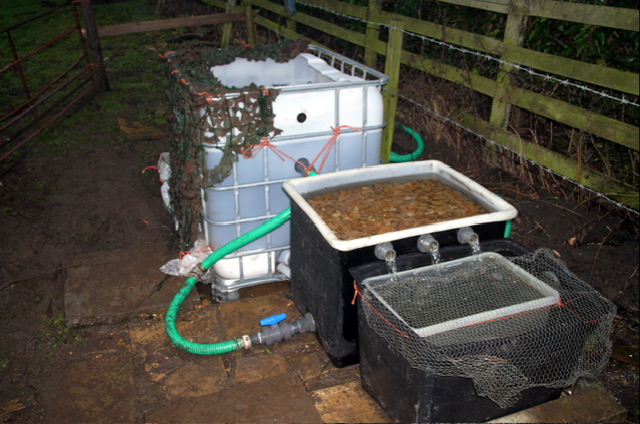
(a picture of the hatchery box with the additional filter box attached)
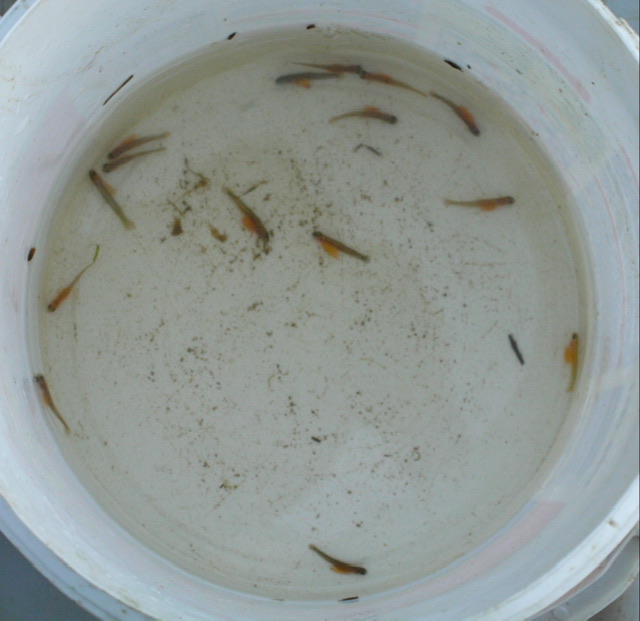
(the first hatchlings, how they should be with the distinct egg sacs remaining )

(a fresh hatched Alevin and egg side by side)
I'd noticed when id come to waft out the water on the top of the tank many hatchings were staying up on the gravel and needing encouragement to waft them through the overflow pipes, into the catcher tank, where they were counted and transported to the stream.
We assumed the light from those three wide overflows, would illuminate the Dark and they would be drawn out of the box. Instead, they remained, determined to stay on top, or just in this gravel sheltering from others, using up that precious reserve but with no seeming resource to start independently feeding.
Talking to others on the roster, they had the same experience and found they were physically encouraging the hatchlings to leave, and many had remained when we shut down the stinky box to put it away.
The walls of the box had been painted black to block the light, but the lid was white plastic and I figured that the light must have been sufficient to draw them up and hold them there, the light from the overflow tubes not being sufficient to draw them further.
‘We should paint it black’, it seemed obvious, I mentioned this in an email to the chairman.
My reply came late in the evening stating that the design required a white lid! That this was the WTT’s design drawn up by Vaughn Lewis, That I was interfering, that I had no experience to and I didn’t know what I was taking about and that I should mind my own bloody business.
Peppered as it was in profanity, this broadside was cc’d to most of the members of the club. It seemed, his chosen weapon of control was public dressing down and humiliation.
I contacted the WTT and said “Look, I think there’s a design issue with the box” and over the phone explained my concern and the issue with the fry holding back. I received a phone call back from Vaugn Lewis himself explaining that the lid needed to be black. That was actually specified in the original construction detail of the box and that we should change that lid or paint it black before we use it again.
Desperately trying to avoid putting a nose out of joint and keep things civil, I sent a private message to the chairman explaining this, I thought without accusation of responsibility, finger pointing or blame. I said that for some reason the original design had obviously been misinterpreted by the EA, not him, and that Vaughn Lewis had advised that we should paint it black with a brief explanation as to why. As a bit of pussyfooting diplomacy, I thought is adequately diffusing and conciliatory, and the matter, therefore, was peacefully put to bed.
My reply again was made public to the members late in the evening. Without the contents or context of my actual email attached for balance.
It explored the concept that I was a treacherous backstabbing creature of low birth and dubious parenthood. That fact being the only obvious explanation as to why I was capable of completely fabricating advice from the Wild Trout Trust, was unable to read or follow basic instructions and furthermore was hell-bent on some twisted agenda to unseat him and ruin the fishing club. In short that I was a troublemaker.
That ruffled the flock into flight, some consolatory emails started swooping around trying to pacify this, including from the secretary who backed me on this. They all seemed to be advising the chairman that he may have the wrong end of the stick here and what I was saying made some sense.
Now backed into a corner the final word was issued forth from camp Tyrant, along the lines of….
“The box is how it was designed by Vaugn Lewis exactly! There is nothing at all wrong with it. I didn’t see any problem with it. He is wrong and interfering, you’re all wrong to get involved, it is not going to change. I am the chairman. I am in charge…!”
(forget about democratic process in this form of club with its officers and AGM system, this was, on this particular issue, now a dictatorship ).
That following year I bumped into the chairman often at habitat days and events, at first in nervous trepidation of aftershocks, but there was none. It was like nothing at all had occurred, unless the lid of the eggbox was mentioned (which I studiously avoided),. . I even had the secretary confide that when dealing with the chairman that he had to pick his time carefully and take a lot of verbal volleys before wearing him down to agreement.
This was nuts, the energy and enthusiasm was there to move forward, but we still had this swamp of human nature and egos we had to trudge through and bog us down.
A few asked me if I would consider being chairman. I said. “No way!” That would mean I chaired meetings with no voting right unless there was a split and I would have to play by the book and be answerable, Id never gets anything done.
Far better to work to this chairman’s strengths and leave me as a kind of free agent.
It was about this time, I just decided to block emails from the chairman and the secretary, and go ahead regardless with what needed doing next and then let them rant, I’d be blissfully oblivious to it.
Connectivity.
Connectivity… was a word that cut across the flow of the Wild Trout Trust report and divided our fishery, isolating the prospects of its population of Wild Fish.
That Culvert bridge that divided the Brook of the Groynes from the Sections upstream, is a solid concrete construction over 5 concrete pipes, it holds back water for an ancient Victorian pump that slowly sends water up slope to a storage pond by the farm buildings a few hundred yards away. You can hear and feel, seemingly through the bowels of the earth an occasional thump as a chamber has filled enough to drive some beam to clatter deep underground like some monster from hell.
Over the bridge trundles the now huge tractors and farm trailers to that distant half of the farm divided by this troublesome Brook. And that poor farmer regularly has to leave the warmth and comfort of his lovely Tractor cab to step down to the muddy concrete and cold waters to regularly free some debris, drifted down and blocking a pipe. He is no fan of it either.
Trout moving upstream are arrested at this spot. A concrete flange that steps up to the pipes is a shallow curtain of white aerated water in which tails find no purchase and making that final jump to the pipes very improbable. Even the Baby Otters fear this feature and Mum must bring them out of the water to wander over the bridge on four little padded feat, before sliding down a bank, back into their element once again.
It looked like a thermonuclear blast would be required to effectively unpick its presence from the landscape. Such a project to replace it, but maintain its functions, required a skill set in design, engineering, drawing, procurement, planning application and funding. It needed an architect, and we had the chairman, and he needed a project to keep him distracted from causing trouble elsewhere, it was ideal.
When the next AGM reared up out of the cold November gloom at some waterhole or other, and that early funny custom of club ‘officers’ standing down and then being re-elected as a matter of tradition, which usually had my rolling my eye and muttering, “Oh for the love of gawd why?! Came up.
This time I made a concerted effort to be the first voice to propose the Chairman for re-election, I caught his eye and got a feeling he was somewhat surprised. Others were too, and I think wondering at this conspicuous change in my behaviour.
It was the first step in a plan to start of looking for ways of curing the connectivity issue within the club, as well as in the Brook, and of promoting him as being the one person in the club capable and up to the task or redesigning that bridge. If he actually succeeded it would be a bonus.
Another thing changed at that AGM… I finally put my foot down, risking a back lash, but it had to be done!.
For years, before these meetings if I was to attend. I would spend a few weeks considering the likely arguments and, in the evenings, looking up reports and research or messaging various river keepers or scientist and asking they’re experience and thoughts.
So, when I was affronted or blocked with the usual ‘common-sense’ logical excuses, I wasn’t left fumbling or silenced. I often had peer reviewed research to hit back with, or a good convincing narrative and I could quote the source, should doubters arise.
If I didn’t win them over then, I’d at least wear them down over the next year and get my way, it was a slow battle of attrition with the end goal to cease all stocking in the Brook, and then see if as I suspected would happen, we would find a lot more fish spread out and sorted through the system, when there no stocked fish were upsetting the apple cart.
In the continued attempt to get the stocking down to a maximum of 400 as recommended, this was losing momentum and people wanted their 800 damaging stock fish yet again.
It was suggested by the secretary as a compromise I guess, to keep all happy. That as we had done so much work down the Groynes and the Nasssington road bridge, and that people were now fishing down there regularly now. That they should spread the stock fish around more and now stock those areas lower areas too.
I stood up, which was unusual for me at these events, and said something along the lines of:- “That is not going to happen! We have wild fish down there now and we have worked hard to get them established, its fishing great, No one is going to be putting stockfish down there and ruining that hard work…., No feck’n way”!
I think the rarely heard F bomb woke a few up, it wouldn’t be written up in official minutes.
My new ally the Chairman heartily agreed. It never made a vote, and it was never mentioned again.
That following year, with addition of the filters, but diplomatically continuing with a white lid, we again put in 20.000 eyed ova and waited to see what increase this new design would realise. And I took on that extra day of monitoring.
We never really got to find the results though…..
Back down at the business end of the brook we had as group work parties or me singly, been putting in some flow deflectors. We organised for the Wild trout Trust to come and demonstrate cleaning gravels.
Simon Johnson the Director of the WTT turned up with a shiny red petrol generator pump and yards of tubing connected to a Stainless-steel tubular lance and buckets full of enthusiasm and infectious personality.
He showed us the likely redds, and then set about demonstrating driving the lance down and the water jetting up ,releasing clouds of silt. He emphasised that the angle is best quite shallow and not to move it around too much, The idea being to shift the silt out of the strata of gravels, not jumble up and loosen up the gravels too much, which would leave them lose and vulnerable to shift downstream in heavier flows..
I noticed as people tried it out, they were not getting this message of subtlety and causing too much disturbance or just randomly prodding it around impatient to move forward, going through the motions, oblivious to what they were achieving.
I also noted that when we moved the kit up stream, It took a combined effort of several volunteers, our three bumbling Godfreys to our one lance corporal Jones, who could create mountains to over come, even in these benign flat lands.
If anyone could take forcibly take charge of a situation and clumsily flood a carburettor it would be him. This was not an operation I could sneak down and do solo or even with one helpful member, it was not suited to the Willowbrook work party model.
A few weeks later I ordered a second-hand petrol driven backpack leaf blower off eBay and had the pipe converted to a long stainless-steel tube. My solo version of the equipment, that couldn’t do as much damage in the wrong hands.
Later that day as people’s attention drifted, I got to talk to Simon Johnston regarding some of the habitat projects that I could point or were planning to do soon, we got onto the fry habitat for the hatchery box.
“Are you using a hatchery box?” he asked.
“Yeah, you guys recommended it”
“But you’re not stripping eggs from the fish, are you?”
“No were not big enough for that, and don’t have the resources, were getting them from the fish farm like you recommended”.
“Really?!! You must have been one of the last we ever suggested that to. We never recommend that now, bringing genetics in is so damaging to your wild fish, even the EA is against it now and moving towards triploid only stocking”.
“We now just concentrate on habitat improvement and connectivity for recruitment”.
I saw the hatchery now as a value to the fishermen, not as a recruitment mode for stock, its days were numbered.
I enthusiastically helped for another year, focusing on those educational aspects and benefits, but not really caring if there was too much success of fish in the stream. They subsequently halved the input to 10,000 hoping that would lower the burden on the water flushing through and increase the percentage of success, it didn’t.
As a final note on this, as a compromise to deal with the lid but without causing a diplomatic explosion, someone suggested putting a dark tarpaulin over the whole system to disguise it. Finaly darkness descended on those gravels, but also unfortunately on the outlets too, not getting the point of the dark lid and bright outlets , it made no difference!
Old Bernard is one of those old chaps, who was old even when I joined the club.
He would be a regular sight on a summers evening near some bushes on the bankside dangling an Alexandra wet fly as he worked downstream and nearly always catching one or two trout of an evening, that would be immediately knocked on the head and secreted them into some plastic shopping bag hidden upon his person. This is what the Trout in the stream were for and why he did it and how he did it, he enjoyed this pastime and more.
Bernard lived in an old stone cottage in a small, beautiful village. One day it will go on the market for an enormous sum of money, likely for some London commuter. When he got it was a worker’s cottage, basic fare. From a big family he has brothers and sisters close in nearby villages where they’ve married other locals and settled, some are butchers and builders and farm workers, he has nieces and nephews far and wide. As well as his own children and grandchildren. And all of them at some time, along with is neighbours in the village, would get the gift of a Trout from the brook in a plastic shopping bag.
Everyone knows Bernard from the pub drunks to the lord of the manor and head of the hounds. If you were born in any of these villages, you were probably tenuously related to him.
If you are overrun with rabbits, then its his ferrets and nets that will clear out your Warren, Moles ruining your lawn? He has the traps and understands were to set them. Hed be as happy killing Rooks, Crows and Wood pigeons as well as Ducks, Geese and Pheasants. You need an extra tractor driver, a beater for the shoot, a farm labourer, a fencer, a hedge layer, a country man, a shovel for hire that could also plough a straight furrow. Bernard in our area, was the answer for many problems and the scourge of any wildlife labelled vermin or game.
Bernard liked things as they were and was happy with the club and the AGM’s. He didn’t take to me at first, but we’d see each other crossing along the banks, me up stream with my dry’s, him down stream with his Alexandra and he’d let me know he’d caught his usual few, but then warn me jokingly that I’d better not have caught more than him!
Id lie at Mayfly time about half a dozen trout just caught and say I was having a blank and id just lost one.
Bernerd started to realise though that if things needed driving in like posts, I was the other guy swinging a sledgehammer or the post rammer and be the last out of the water doing the labouring and the first to pick up any gear to carry.
Gradually I gained some value in his eyes. He didn’t like where I was taking the club though and reducing stocking was potentially ruining is way of life and happiness.
He put his heart and soul into the eggbox project though and raising those fish, and any habitat work, Bernard would always turn up and get in the heart of the action. I guess it appealed to the farmer in him. But with stocking he preferred to keep things as they were and couldn’t be doing with scientific explanations and research.
One evening, soon after we had ceased stocking, much to his vocal displeasure and distrust. I was exploring up stream and caught sight of Bernard coming down towards me, this was no casual encounter. He was not in fishing mode, he was heading straight towards me and I felt sure I was about to get an earful about the awful fishing now with no ‘stockies’..
“Aye up Bernard, is everything all right”?
‘I’ve just had one of your Trout Chris”
“My Trout? What do you mean, my Trout”?
“One of them wild ones, it was small and golden with bright red spots about that size”
He held his old labourers hands apart and indicated about 6-9 inches
“Oh, brilliant Bernard, that’ll be delicious cooked up for your breakfast!”
He looked at me almost horrified. “What? I couldn’t kill it was beautiful, I put it back”.
If ever a moment summed up the value of that hatchery box, there it was.
This last AGM Bernard turned up looking frail, I’d seen him earlier in the year and wondered if he’d have the strength for the banks now. He seemed to have rallied a little and the glint was back in the eyes.
“Hello Bernard, nice to see you fela, did you manage to fish much?”
“Not much Chris, but I had one good day at the end of the season. I had one fish on and I really struggled with it, must have been two and half pounds, I never dreamt we’d get fish like that in this Brook. what a great fish.”
“Wow, Benard I’m so glad you got one of the bigger fish. See, they are in there!”
“Oh I caught another straight away almost as big, then had a little one about half a pound’
“Three in a session” I said grinning, “that’s up on the usual two isn’t it?”
“Oh but then I saw another, looking down from the bridge, I could see it feeding, it was even bigger Chris. I knew I could catch it, but I couldn’t work out a way of banking it and getting it back in safely without damaging it. So, I just had to leave it in peace, it was such a lovely fish.”
The transformation of Bernard was complete. Bollocks to old dogs, not learning new tricks.
Sometimes the benefits aren’t always what we expect.
Happy new year, tight lines and dry waders!
( and for you who got new Hot Torpedo for Christmas…….. I hate you!)
pom