David Siskind | Sunday, 18 May 2025
This was Catskills week. This of course is storied water, where the pioneers of American fly fishing developed their methods. It’s where the Dettes tied their flies, the Wulffs, Leonard Wright and the Darbees fished, and of course Theodore Gordon. I’m leaving out many people but you can visit The Catskill Fly Fishing Center and Museum, in Livingston Manor, or virtually, to learn more about them and the history of our sport. It had rained hard for a few days last week and the three rivers I went to fish were running high. By the time we got up there on Monday, the Willowemoc and the Beaverkill had cleared but the volume was still up. Insect activity wasn’t enough to get fish to show. There were some residual Hendricksons, early March browns, grannom caddis and yellow sally stones as well. The fish weren’t responding. The Delaware was running too high to wade effectively.
The Catskill Fly Fishing Center and Museum
On the Willow we waded and fished the bank-adjacent soft water and dissected the seams off the bank. But there’s just too much water, too many rocks, holes,and seams, so I tried more efficient ways of covering water. There’s a lot of good fishers on these rivers. Good casters, tyers, And many of them talkative. I learned a lot. Most everyone fishes across and down. The presentation of nymphs and dries start with a straight line cast to a target above the water to be fished, and a lift of the rod tip to pull the flies into the target lane to be drifted. It’s very similar to the drag and drop presentation common to carp fishers. Then maybe a mend followed by feeding line into the drift. Almost no-one is casting curves or slack-line upstream to lies or feeding “heads.”
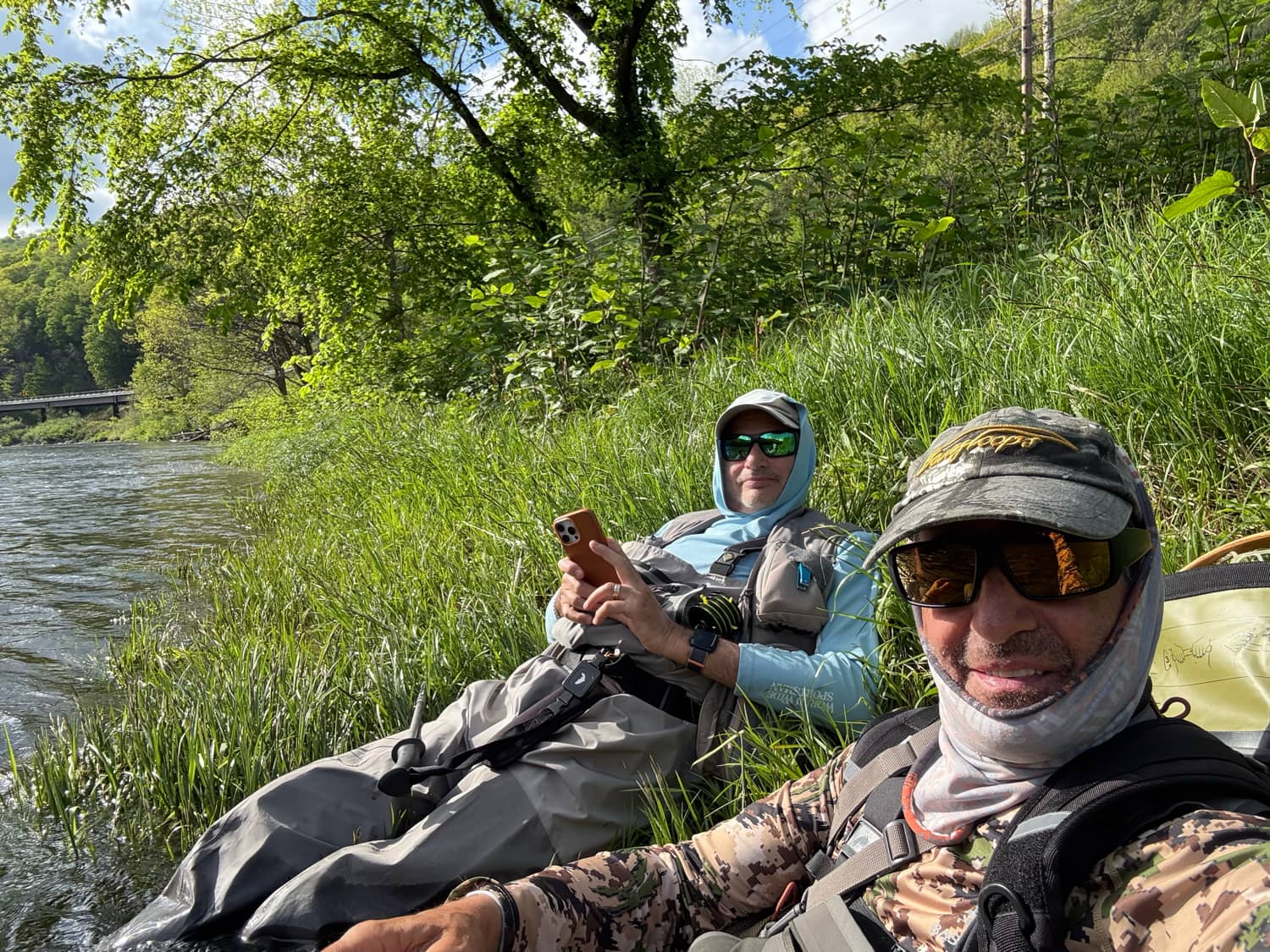
Neither did I see anyone contact or euro-nymphing although I understand it’s gaining some popularity here. I met one fellow from New Jersey who fishes these rivers 100 days per year. He was fishing nymphs under an indicator, roll-casting, pulling his flies into his target drift and feeding 30-40’ of line into the drift, covering a lot of water. But no one was catching anything. Unusual for these waters. I managed one parr-marked brown on a dragging emerger but that was it. Our efforts on the Beaverkill were equally unimpressive. After covering a couple of miles of water, we settled into a cool bankside sitz bath (see photo), waiting for a trout happy hour that never came.
Wednesday we floated the West Branch of the Delaware from Deposit to Ball’s Eddy. We were ably and cheerfully guided by Pistol Pete out of Cross Current Outfitters in Hancock. I got a chance to try what all these streamer junkies are doing these days. We cast 4-5” articulated flies on 7 wt SA Sonar sinking lines (the “meat-sticks”), mostly working the bank but also targeting submerged grassy edges and deadfalls. Casts were all straight to the fly which was stripped immediately and aggressively. It’s hard work but, I think, entertaining enough. I should be working on my retrieves. The fish were not very active, we probably moved 10-15 fish in 8 hours, and hooked four. Marty brought two to the boat. Seeing trout behave so aggressively is a hoot.
Finally, toward the end of the day we found some “heads” eating on top. Happy fish. I fed a pair of dries down and across to a nice one and got a lovely eat. Ultimately it straightened the hook by the boat and swam off. Fun stuff all. Lots of precision casting, and lots of learning.
Wyoming is next.
David Siskind