Graeme Christie | Tuesday, 6 October 2026
Three trips to the same tidal water.
The first was wind. A 10 weight and Martin Langlands' white smelt. Two sea-run browns at dusk, both after the evening tide had turned and started out. I talked about this last week.
The second had the better forecast. I turned up at midday, later than planned, to a light wind that was getting stronger and a tide coming in. This time I was fishing my HT 8 and 6 weights. Four swirls at streamers. Two fish rising in a lull. I spooked the first. The second got a long cast, bang on. It looked at the buzzer and left. Encouraging, but not as hoped.
Then the wind went east and a sludge started moving across the surface.
No fish. I drove back to the accommodation. My fishing is always a work in progress, though effort and time usually lead to results. My thinking was ebb tide, sun, light wind. Plus this is NZ, the planets need to align!
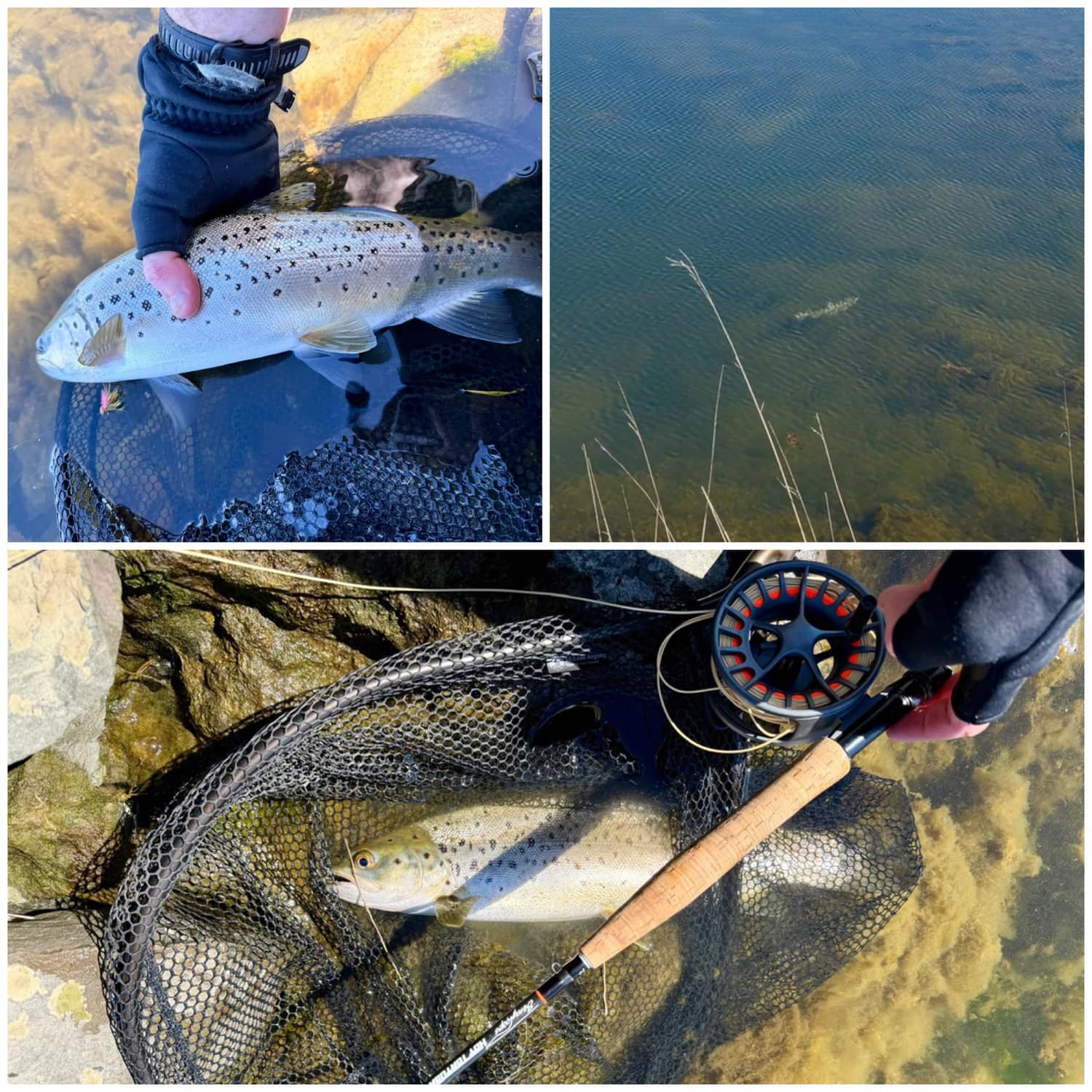
Sunday was looking very good. Four degrees at seven. No cloud. Two Hot Torpedoes rigged, a 6 and a 7, both with a dry dropper and differing buzzers. Another rod with a streamer. My wife told me as I was about to leave that this was my normal over the top set up, but I like it that way and it works for me.
The first chance came before the turn. Top of the tide, a fish on and then off. Either large, as I couldn't stop it, or more likely foul hooked, as I struck late on the take. I missed another take around then as well. Fish were cruising in the shallows, their mouths going. Whether rising or subsurface, they were feeding often.
Then the water started to drop and fish started to rise along an expanse. I also quickly worked out that once I had some action, whether one on or one landed, the other fish became wary and fooling them got hard. These fish are schooled and understand that there are threats out there!
On the dry dropper, buzzers, a 12 and a 14. A foot of tippet under the dry, which tells you how high they were feeding in the bright sun.
Missed a take at 11.20. Hooked another one and lost it. Then landed one at 11.27.
Missed at 12. Hooked again at 12.20, lost. Landed the second at 12.32.
Missed at 12.45. Landed the third at 12.56.
Three from ten. The log is less flattering that way and more useful. As time went on my hook set was less frantic and more deliberate, which gave a more positive connection to the fish. I'm a work in progress, like us all.
A comment on the casting. There is a fence in the way here and it is a unique obstacle. Just as you go to deliver, if you drop the legs of the cast, the fence punishes you. I was pleased to get away with minimal entanglement. Separate to that, the dry dropper set up behaved very well. In the past it has been a source of tangles, and they just didn't eventuate, which showed some nice progress. Lifting the arm on the back cast is something I notice in the very good casters, and it has been an aspirational goal of mine and it does look like it is something which is working. A few days of casting did leave me sore though. The gym work is something I'll look to incorporate more.
All three took the 12 or the 14. Different colours, black overall, varying between flash, UV features and red/orange cheeks.
Silver fish. Fat, clean, sea-run looking browns that had been eating well somewhere salty.
At one o'clock the wind went east. Only a few knots. The rises stopped.
So the theory holds. Except the ebb was getting on by then. And when I looked at the flow data that night, the water coming down had been climbing all morning and flattened off about the same time.
Three things changed at one o'clock. I only noticed the wind.
It's likely just the low wind that matters.
Streamer for the afternoon. One bite at 2pm.
Two flounder in the shallows while I was catching the trout, right where the fish had been rising. That shows how brackish this water is.
I do enjoy the different water that trout inhabit. They are a very hardy species. This is farming country, like most of the places I fish, and the farms carry a lot of the local economy. Intensive land use does show up downstream though, and I suspect the sludge is part of that. There is a lot of clean, well oxygenated water moving through, which is likely this place's saving grace. Plenty of farmers are already fencing and planting their waterways. I'd like to see all of us, town and country, keep bringing the nitrogen down. It is a hard issue for any government, and I understand why.