Martyn White | Thursday, 29 January 2026
This week I thought another old saltwater pattern was in order and I've chosen a deadly one that sometimes doesn't get the love it deserves: The bendback. Perhaps it's more of a style than a specific pattern, but the advantages of the style - and the problems some have with them - are fairly universal across all the different bendbacks.
Why fish a bendback, well they are simply the most weedless, snagproof option available to us as fly anglers. Some people say they don't hook fish, but much like weedguards this is 100% down to user error. A badly bent hook is weedless and fishless, but a correctly bent hook is just weedless. Even if they hook slightly less well than an unmodified hook the number of eats in the situations you use them is likely to be higher and should more than make up for the supposed inefficiency in hooking. For example, if you're bashing mangroves or other snags, once you develop the confidence in how snag resistant these flies are you'll confidently put shots in closer/deeper in to the cover than you will with a conventional fly because you KNOW the bendback will slither out between the leaves and sticks, even if you manage to present your fly in the branches above the water's surface a gentle pull will get it back and may even allow you to drop it in a fish catching zone meaning the cast isn't wasted. Much better than snapping off or taking the boat into the snag to retrieve the fly and spooking the area. Grass, weed and lilies are the same, fly coming back clean every cast? Then it's fishing effectively If I bounce a fish when I'd otherwise be cleaning weed from my fly it's not the end of the world, I know that on all the other casts the fly will still be fishing as intended and I'll have no frustrations or qualms about fishing right through the cover.
I'll go even further on this and say that I don't really believe the idea that a properly made bendback is no less an efficient at hooking than an unmodified hook. I don't hook every fish that eats my flies, and I don't know anyone who does but with a standard J-hook no one is blaming the hook shape. Sometimes you hit bone or the hook turns awkwardly or something and the hook doesn't stick, and I really think the idea of the bendback hooking problem is largely misattribution. Simply blaming the difference for something that could or would have happened anyway.
I'll go even further on this and say that I don't really believe the idea that a properly made bendback is no less an efficient at hooking than an unmodified hook. I don't hook every fish that eats my flies, and I don't know anyone who does but with a standard J-hook no one is blaming the hook shape. Sometimes you hit bone or the hook turns awkwardly or something and the hook doesn't stick, and I really think the idea of the bendback hooking problem is largely misattribution. Simply blaming the difference for something that could or would have happened anyway.
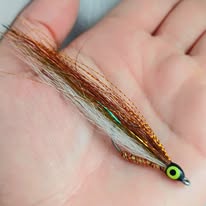
A simple bend back pattern
Hook: manually or pre-bent hook
Thread: flat waxed nylon
Body: tinsel or pearl braid
Wing: white bucktail, flash, darker bucktail
Eyes: if you want
If you don't want to bend your own hooks, there are a few commercially available bendback hooks; the Ahrex bent shrimp is good for light duty, the Ahrex CA bendback is heavier and comes in bigger sizes. Umpqua also make one that looks a good shape, but I haven't used it.
If you bend your own, do not over bend it. This is the main reason that the hooks fail or don't hook up. You should be able to draw a straight line along the bent section to about the middle of the hook bend.
There's a bit of flexibility in the wing materials, but avoid anything that can dreadlock. SF blend, EP fibre or equivalents and woolly materials are out, bucktail, marabou, well cleaned craftfur and saddles are in.
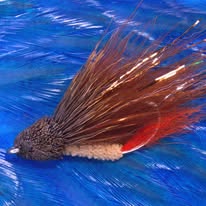
Add cones, beads, wire and/or muddler heads to get different effects.
Here are a couple of other options
Chico's orange and yellow bendback - the hackle gives a bit of volume and obviously you can mess around with colours
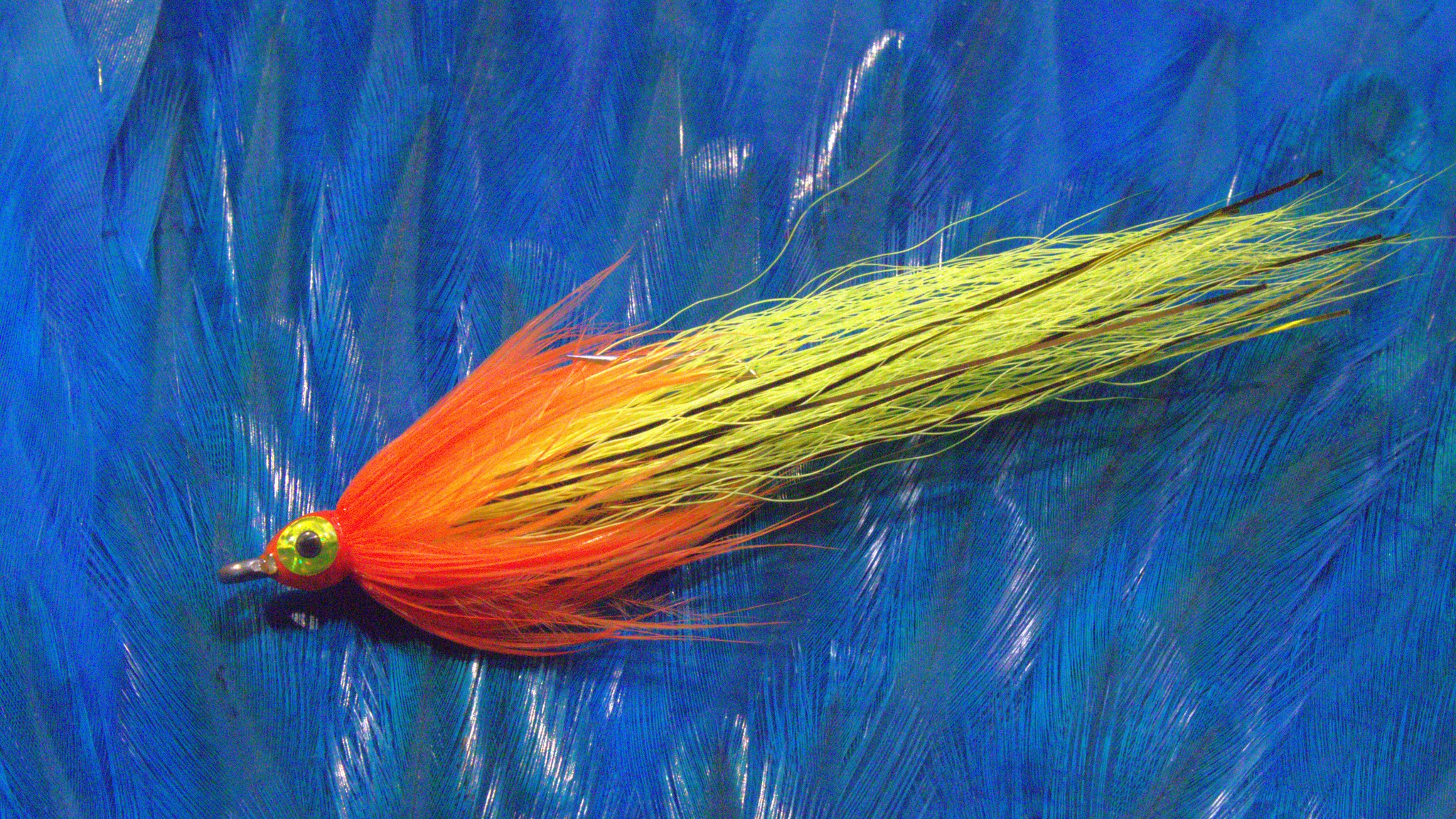
The Copper Liz- a red fish fly with a bit of lead to balance the buoyance of the muddler head. I works for lots of other species and is handy in stained or dirty water