Rickard Gustafsson | Saturday, 10 October 2026
When practicing your casting you probably want’s something at the end of your leader. Sometimes it should be a the flies you intend to fish with, with the hook bend cut off. But most of the time you probably go for just some “fluff”. It hurts much less to be hit by fluff. Hurts your rod less to be hit by fluff. Hurts your leader less to have some fluff attached.
If we start with casting without anything. You’ll soon crack the tip of your leader. The good thing is that it makes it much easier to do a whip crack with your cast. I’ve heard one teacher using this as a teaching tool, if you hear a whip crack you’ve done something wrong. I’m not totally convinced this is a good idea. One reason being that casting without anything at the end of the reader feels a bit strange. I would say that I can feel a big difference when casting distance and the fluff is gone. It feels off. I have the idea that you want a balanced size of fluff. I don’t think a very small piece of fluff is an advantage in a distance competition. It is like it helps keep the line stable. So a bigger piece of fluff than you normally use can be worth experimenting with.
A lot of things works well as fluff. In the beginning I used a piece of gift wrapping ribbon, a textile ribbon. Not the plastic ones. It was what I found when I was looking for something that could work as fluff. It ended up working so I didn’t have a reason to get something else. And it worked as everything else that is more commonly used as fluff, after a few false casts all the fibers have separated. Other things I tried to use as fluff early on was a candy wrapper. First I learned there that the size of the fluff has an impact, a light line has no chance against even a candy wrapper. A smaller piece of the candy wrapper doesn’t hold up very well and when it holds up it twists your leader very well.
Then I got some regular yarn. That works very well. Acrylic knitting yarn floats decently. Floats very well with some floatant applied. It is cheap and exists in any colour you can think of. It is easy to split if you want it thinner.
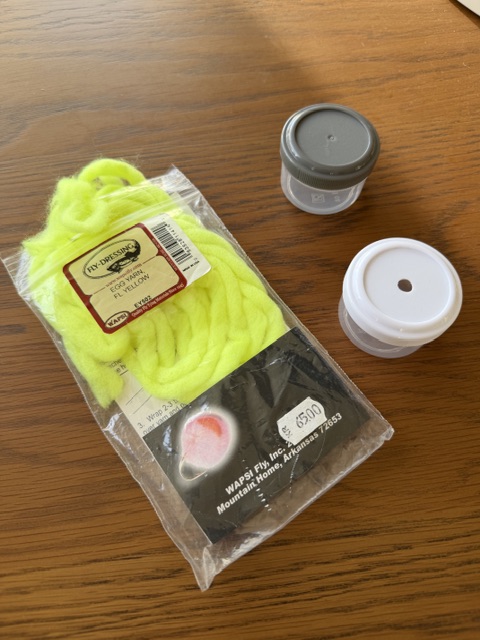
And the golden standard, egg yarn! This is a very popular choice. More expensive than regular yarn, and I’m not sure that it has any actual advantages more than it is thicker than regular yarn. So you have to split it. It might hold up better than regular yarn though. Managing egg yarn can be hard. Keeping it in the bag you bought it in, just pulling out one and hoping it won’t escape. That’s one strategy. An other is to put it back in the bag, than hoping you will find the end of it. ’ve been looking a bit for a fitting container to solve my problem. A film canister would’ve been perfect. But we don’t use that anymore. Or not as common as it was when I was growing up. I guess you can still buy film canisters, but this problem hasn’t really been top priority to solve. But recently I happened to be in a store with knickknacks on constant outlet price. I was walking around there as I was looking for something even if I wasn’t. And there it was, a good container that could be used to create my fluff dispenser. A set of very small canisters, too small to be useful for anything really. But perfect to drill a hole in the nice screw on lid and fill it with eggyarn.
Other things I’ve tried as fluff is the core of paracord. Strong as hell and I would say a bad idea. It has some good properties but the strength is a disadvantage. Because when the fluff hits your line or leader for some reason it can make very interesting knots. Knots that cannot be untied. With something less durable than paracord you can hopefully pull it apart with your fingers and not hurting your line in the process. Something like paracord and you might not even solve it with a pair of scissors even. So really consider this choice, even if it floats well.
The reason you want something that floats quite well is that it can be nice that it doesn’t sink when you practice your roll cast. And you want the material to not pick up too much water, and shed the water it picks up easily. So you aren’t fighting against a wet rag when you are practicing. You want it to hold up quite well, but not too well. You want it to be cheap, I guess.
And you want to have it, no fluff no nice. I’ve had a leader without fluff come sneaking in on the side of my glasses, that did hurt more than expected.
You also want to take a bit of care when you tie on your fluff. You can end up with a small helicopter at the end of your leader. I tried something very special going into my first competition. Nail knotted and glued the knot. Or maybe that was the problem, I fiddled too much. A regular knot in the middle of your fluff piece seems to work well enough. But I’m open for suggestions here.
Cheers, Rickard