Tracy&James | Wednesday, 18 March 2026
Well I finally got round to doing some fly tying whilst Tracy was away for a week working. I suspect I'd been putting off starting due to some anxiety regarding my dexterity after my accident last year (a badly broken hand). I haven't recovered full movement and neither do I expect to now, however things weren't as bad as they could have been and my fly tying was up to its usual mediocre standard (which is usually good enough to fool a bonefish).
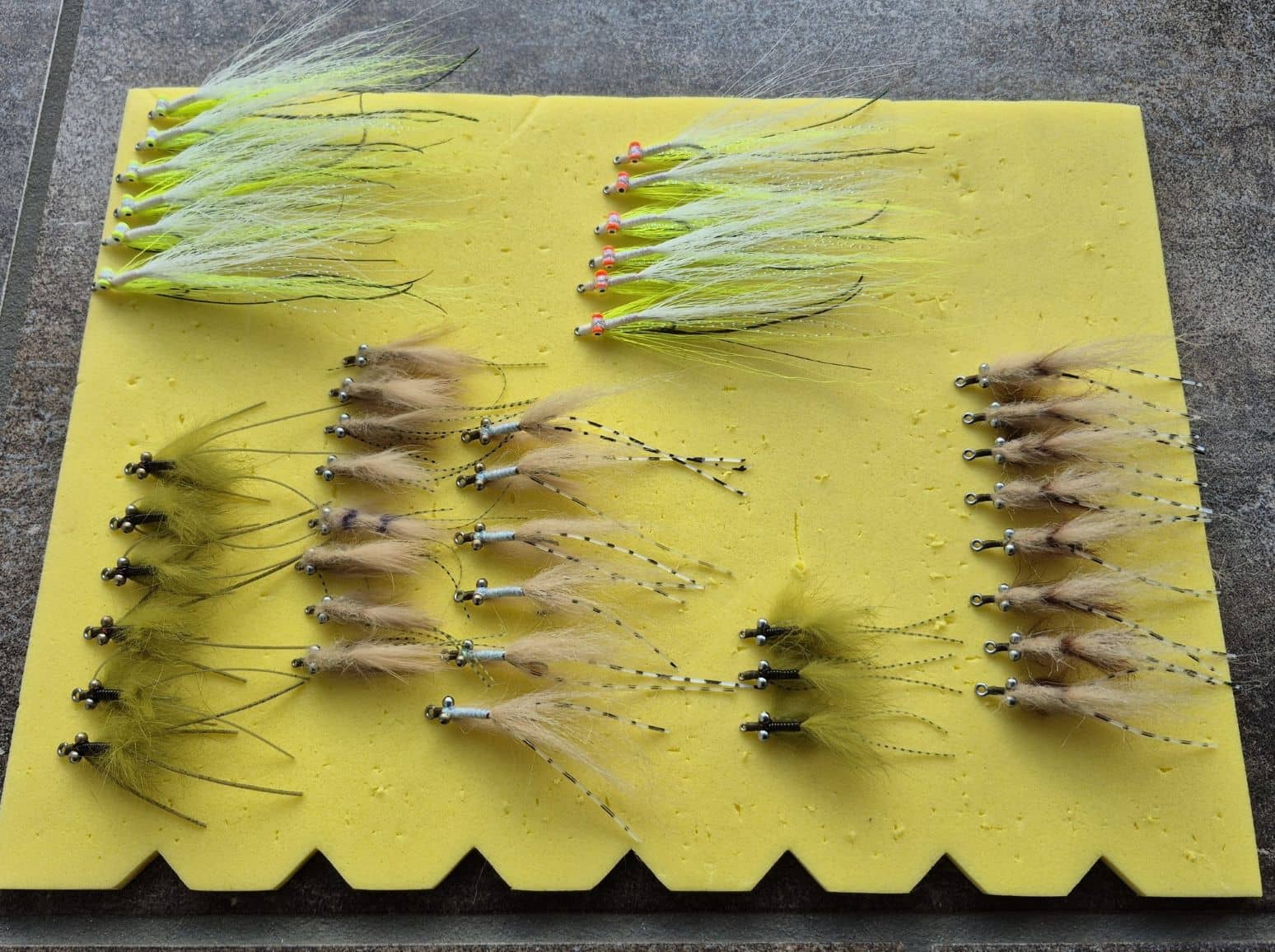
I started by topping up with white/chartreuse Clousers as these are as easy as it gets to tie. Rather than rib the hair with tying thread and then epoxying it (as per the standard pattern), I use a flashy flat braid to form the body. I do this because I feel the original tying is a little vulnerable to the teeth of most of the species that we'll be chucking Clousers at – various snappers, jacks, needlefish, ladyfish and cudas. My flies still suffer mind you, but I do feel they're a little more resilient the way I tie them. Being as I didn't really have bonefish in mind for these flies, I tied them quite large – on a size two hook and with an overall length of around five inches. These still cast well on a bonefish outfit although we do beef up our leaders to help turn them over. Obviously for cudas we add some wire bite tippet – usually AFW. A four or five pound cuda on a bonefish outfit is great fun, however we do have our #10 weight outfits in reserve for the bigger ones who want a budgie sized fly. That said, the biggest cuda that Tracy hooked last year took a Clouser on her #7 rod, or rather it took the ladyfish that took the Clouser – that was easily a 20lb plus fish.
Next up were the bonefish flies. Now my flies are incredibly dull – they are all essentially the same pattern but in a couple of different colours and a couple of sizes, namely size 4 and 6. They almost always contain rabbit fur as I want some movement even if I'm just inching the fly along; one thing I've noticed about a lot of bonefishers is that they are fixated on a standard strip retrieve. I suspect that this may come from fishing on skiffs where a certain strip speed is required just to keep pace with the movement of the boat plus they have to move the fly on top. I know last year when Tracy and I had our first guided day for a number of years my stripping was way too slow on the first shot – I had to make a rapid adjustment after that. With the vast majority of our flats fishing being on foot, we're used to employing a much bigger range of retrieves. For example, I've lost count of the number of bonefish I've caught using a figure-of-eight retrieve or even a completely static fly – not every prey item shoots off at a hundred miles an hour.
Another thing my bonefish tyings have in common is weed guards – I don't tie any flies that don't have a piece of nylon that's tied in backwards along the shank of the hook and then looped over and tied in at the eye (I then double back the tag end and trim it to shield the hook point). These weed guards certainly cost me the odd lost fish over the course of the trip, however I firmly believe that I hook many more fish because I'm less likely to snag up or hook some debris before the fish sees it.
As I type, Tracy is busy packing. I did the usual thing of getting all the tackle together and dumping it in the middle of the floor ready for her to unleash her Tetrix skills to get it in the cases. The rule is fishing tackle first, clothes and other stuff second. Luckily where we're staying has a washing machine so I only need two pairs of pants and two T-shirts in addition to my fishing clothes. Obviously we'll wash these pants at the 3 week point of our holiday!
Hopefully by this time next week we'll have some bonefishing to report upon, until then I hope you have a great week.
James.