Chris Avery | Wednesday, 27 December 2023
After all those years with one wheel in the ditch, and the other on the track…, Suddenly, thanks to that report, it seemed that the Willowbrook fly fishers club had finally two wheels on the tarmac and was rolling along!
The EA (Environment agency) with a wee extra nudge and some guerilla gardening had transformed the “Above the Packhorse Bridge” canal stretch into the potential loveliness that is now “The Groynes ”beat..
A certain rebellious gobshite had realised that putting the odd faggot together wasn’t too hard and was now ambitiously looking at that WTT (Wild Trout Trust) report regarding his beloved Nassington Road Bridge beat and thinking, “Do I really need to wait for the club to get round to it…”
...I mean me with my head down working alone, he thought rather arrogantly, I can do as much as four members more intent on chin wagging about putting the world to rights, or. as often happens, having one know all being vocal about the authoritative way to tie a piece of string, while the other three glaze over and just wish they could stand aimlessly staring at the water flowing by and just enjoy being, and enjoy being out, and enjoy being in pleasant company with the occasional bout of idle reminiscing to break the awkward silences should they occur
Three bumbling private Godfreys to one well-meaning Lance Corporal Jones…
There were areas in those lowest beats full of tasks that I could get on with without bringing too much attention to myself. Online I found a couple of handy illustrated guides on river restoration projects from the USA with some great ideas and showing ways of making your works look like an established part of the stream and I slipped the little grey cogs into gear and planned and schemed,
Meanwhile, upriver by the Chairmans house below the level of the banks by a mill house there was the hatchery box being put together and members were buzzing around like those bees first leaving the hive in spring, bumbling into objects, clumsily feeling their way into flight and industry again after a long lazy snooze then gradually some sort of order appears, and the pollen starts to come back to the hive. Somehow that box came together and a feed pipe syphoning water from the brook was established from the head of water above the mill and we are ready for the eggs.
A reawakening of some enthusiasm and optimism within the brethren with this gentle nudge. A fresh new direction for the fishing club and a project, that, let’s face it, was not what anyone would have imagined or considered probable even a year back. We were about to raise our own Trout to stock the Brook with. What an awesome prospect!
Here next door to the chairman was a ‘beautiful’ large cottage that used to be a working water mill. Sat it seemed from one angle, atop of the large mill pond, from where you viewed on its little gracefully arched bridge of hewn sandstone blocks, That same local material for the garden edging stones of the wide herbaceous border and the ghat like platforms stepping down to the water along one side. All terribly decorative and devoid of function.
Years removed from the grime, smoke and clouds of dust when this was an industrious working flour mill, Sacks of grain coming in, bags of flour going out, and fresh dollops of horse droppings remaining on the cobbled yard.
This sandstone, though traditional betrayed the genteel conversion to 1920’s English Arts and Crafts style of Constable Haywain nostalgia.
Those gentle rushing waters in the tennis court sized mill pool surrounded by smooth mounds of manicured lawns and tight clipped hedges. And opposite, in full view, a small wooden picket fenced field of carefully spaced and pruned fruit trees stretching along the bank of the Brook on one side and the mill Leat stream on the other, both of which disappeared out of view to join up in a wooded hollow before winding along the long sloping back gardens of the village beat.
Here between the fruit trees immaculate raised vegetable plots with regimented rows of naked bean poles and peas sticks redundantly now at attention after the cold Autumn winds had stripped away the greenery, and that waste was now neatly stuffed away in the steaming compost heap by the little painted wooden greenhouse and its cold frames, this garden supposed operational nerve centre. This area was not so much for the produce, it was a statement for the cottage and its owner, just the same purpose and use as the bag of pellets and the few chubby Stocked Trout he paid the club each year to restock in his mill pond. “I have Trout from a Trout a stream by my garden in the pond just outside of my door”.
It was a rural idyl, a dream he strived to create, as real as a film set.. Even if those Trout were none native and they were bred in a bucket and delivered here crammed in a nasty white polythene tank on the back of a rusted old Utility truck! It was just a Plastic veg garden by a fake Trout stream by a posh comfortable house pretending to be those good old days of real ‘England’.
My mum coveted a similar nostalgic conceit, but would make do, by buying the image on a tin of Biscuits or the lid of a box of chocolates.
Looking back at the Cottage, the water from the wheel poured out from underneath the building beneath the lead glazed French window of an opulent living room, not a dusty old grain store now. Out it tumbled into the mill ponds round surface, fringed with Irises, blotched in summer with water lilies, and occasionally disturbed by the swirl or splash from some large dark mysterious Chub or one of the fat Stocked Trout no one could be quite sure which. Every morning the owner would throw them a handful of pellets to keep them close , but eventually, they’d either start the slow drift downstream and lose condition or they’d succumb to the Heron or the Otter and their fat remains cleaned up by the feral minks.
Or maybe they would be swallowed whole down the gullet of a Cormorant. After a month or two he’d be feeding big fat grey flanked Chub and hoping vainly that they were still spotted.
Nearby under a thick disguised concrete slab where the Leat vanished under the track to the bridge, On either side of the water was a surprisingly clean concrete shelve a foot wide, and placed in the middle regularly was a stinking brown smudge of matter that the Dog Otter had left. His tag proclaiming “I am here”.
I’m sure he enjoyed those daft stock pond Trout freshly delivered to his lair each year
And as a final flourish of the scene on a mound on the bank close by the cottage most summers, was the scruffy dome of dried weeds and bird pooh,, A nest of two large white swans to garnish the bucolic loveliness and to safely raise a family to gobble up all the life giving Ranunculus from the Brook.
“You boast of a Trout stream past your front door and provide sanctuary for this menace of the habitat ,and then you put stock fish in to dislodge any native trout that might exist!!”
I call Swans albino Cormorants, for their shared damaging impact on this stream, The devastation caused by one nesting pair on hundreds of yards of narrow Brook is often a heartbreaking frustration as what was recently generous beautiful rafts of water crowfoot and clear gravels, becomes a bare bed and large divots of silt as they have stripped everything and grubbed up the remaining roots, The flow slackens the silt builds up and the burr reed and bullrushes move into to choke the water.
I love seeing them in flight they are so uplifting and beautiful to behold, they are fabulous creatures full of character, but the sign of a nesting pair settling in on the brook, has me praying for, and siding with the Badgers and Foxes to succeed in upsetting their domestic bliss.
As Trout habitat goes they are a huge menace in a small stream like ours.
This picture book perfection around the Mill could only be England, the kind of place that gets the modern fly fishermen reaching for the split cane, and a wicker basket creel on the shoulder of the ancient tweed jacket. And I am labouring this point like mad because it’s what we were up against here. A parody of natural.
Around the back this building the Mill still had the big water wheel now stilled and stationary, and those benign almost static waters of the Brook 50 yards upstream start to quicken in pace as they are tugged forward to a decision. Here divided by a small island, to either run down the left channel that plunges down to the wheel pit then spew out gently roaring into the mill pond beneath those French doors. Or, to take the excess water route to either cascade or be mysteriously swallowed down a coffin sized rectangular opening, plunging the water down to lower depth.
I’ve never been able to understand its function. Looking down into the speed and depth of that cascading water and the darkness below you didn’t need Dante’s foretelling of “Abandon all hope, Ye who enter here”. Its mysterious purpose added to the foreboding. It always bothered me.
The rare occasion of wading in that area ( dark at night in a howling storm wit rising waters trying to save the flow in the hatchery box) I was constantly aware of the dark peril and my exact proximity to it. The remaining water that avoided this fate glided down a shallow concrete slope around 15 feet and tumbled the last foot into that mill pool.
Today looking at this feature and planning a future project for the fishery I pondered on the chances of fish navigating this upstream hurdle? The jump was no problem but the white, aerated water on that 15-foot shallow fringe might resist the purchase of a Trout’s tail to propel it forward sufficiently.. Maybe this will be a fish pass situation?
The Willowbrook’s waters had travelled here through another canalised channel only much deeper than the Groynes, and this constant slow flow preserved to an extent by an old, rickety sluice gate, in a large old concrete structure 800 yards upstream. This controlled a man-made side stream called a Mill Leat that flowed out in a wide, almost square route around the low laying paddock, arriving back to meet the main brook just below that mill pond.
A ‘Leat’ helps a stream at the Mill hold a head of water to drive the wheel. This one though we referred to the ‘Leat’ snook around to meet up again at a lower level downstream. Strictly speaking I believe the canalised section is really the ‘Leat’ and the small stream meandering around the field therefore is the remains of the Brook… I guess.
Nothing is straight forward as its named, it seems at the Brook.
Nearby that old sluice gate that manages the levels, across on the far bank are just discernible under the weed stems and the sapling covering, are old mounds. Here in this shallow valley where those bronze age farmers who first cleared this land from the primeval forest and started to work it. When the toil for that life was over they were put to rest within these mounds ..
Across on a higher pasture above the Mill stream is the site still marked seductively on the Ordnance survey maps as ‘Gold Diggings’ where the Romans had built their large, heated villa, the offices and trading post.
Immediately above the ancient sluice gate is the woods and the water is the boundary line. A short stroll through this wild tangle up stream you can fight and stumble up to the high sluice gate that controlled the level of that large shallow mere in the grounds of Applethorpe hall and that marked the end of our bit of the Brook.
I tried to enter those woods today to explore for areas of shallows where people in the past have spotted Trout breeding here and see if we can supplement the gravel and flows up there to again and make this a nursery ground.
But many large trees have blown and split and tumbled since I last explored up there a dozen years or more, Huge collapsed limbs still sprouting branches ,no longer in the canopy but now creating the undergrowth. Tangled and impenetrable the way the game keeper likes it for his pheasants. Bringing up a chainsaw to clear a route in, would cause a diplomatic incident that would only go against us I fear.
The owner is the present lord of the hall and I need to ask him directly for help or permission for this project after the pheasant season is over. Apparently, he likes to fly fish for pike on his lake, so we have some common grounds at least even though are blood lines are classes apart.
Back down at the Mill house the club choose to plunge a filtered head down in the river just as the water accelerated towards the sluice near that the ominous opening into the old water wheel pit.
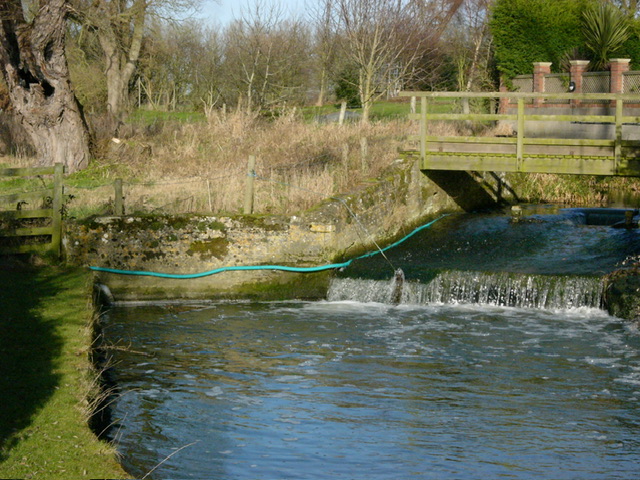
(the green pipe from the Brook to the Eggbox, the only sign that it was there.)
The hatchery box was positioned 20 yards away on the lower level of the mill pond and the out flow pipe from the box fed out into what we called the Mill Leat, a winding shallow channel here, about the width of a car , It journeyed its way along back into the Willowbrook. (And ironically probably the best fry habitat for miles. we could have just let them go straight in, It was discussed at the time but so many objections put in the way, it became an argument that would never be won, with an entrenched secretary that hadn’t come up with the idea).
The EA had offered to pay for the Box Components if the Club paid for the 20,000 eyed ova to seed it. 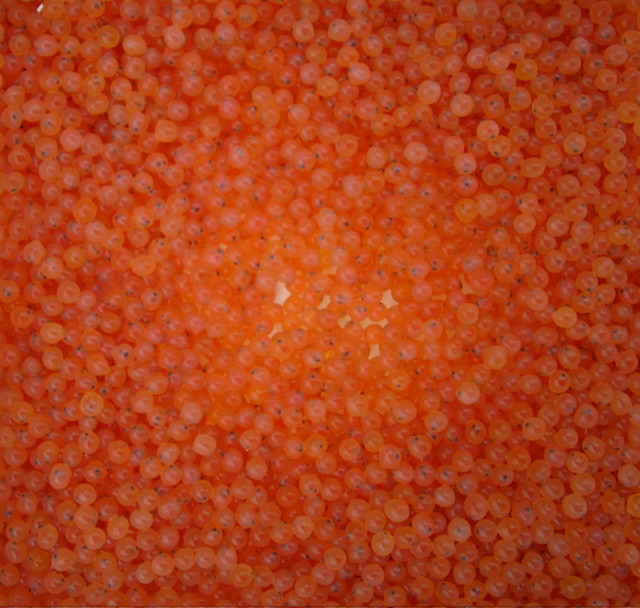
(Eyed ova as they were delivered)
Meanwhile at the AGM the club had quickly agreed enthusiastically to go ahead and buy the entire 20,000 recommended eggs. But then take its usual diversion into that convenient slip road of obfuscation rather than address the prospect of reducing the stocking of adult fish from 1000+ down to just 400 as recommended by the Wild Trout Trust. What to me and a few others, seemed to be the whole point of this exercise! But those members present got back on to the topic again when a ‘compromise ‘of 800 was mentioned and voted it through.
It felt like a wheel slipped back in that ditch, yet again. I resisted a flippant comment that those extra fish should have plenty of fry to feed on next year but kept the observation for private conversations.
This was going to be a long slog!
It was decided that we would need a daily check to clean the filter etc and seven of us volunteered. Once the eggs were in the roster began.
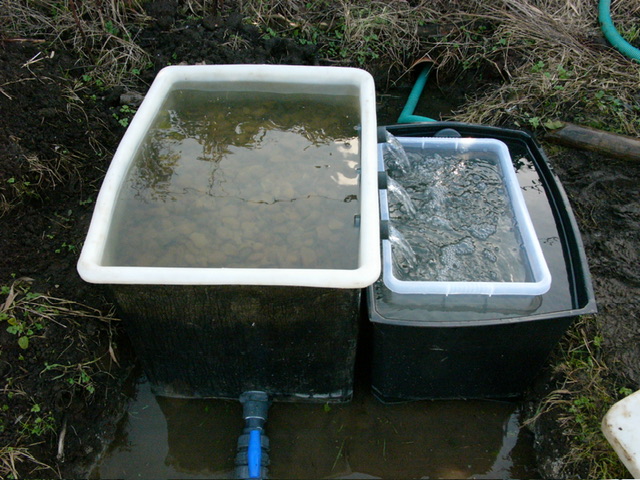
(the basic hatchery box)
A typical visit would involve closing off the inlet to the box, going to the river and either raising the instream filter just under the surface and brush off and debris and weeds or use a long-handled brush to dislodge any debris. Then take the lid off the egg box and waft the surface with what was usually an icy cold wet wooden paddle to free up the silt settled in top layers of the gravel and flush it through the outlet If you did it well your fingers were red raw and burning with cold. There was surprisingly a lot of silt to shift.
Then just open the inlet valve again and check it was running fine and take the temperature of the water and plunge your hands deep in your pockets and seek relief.
Twice I turned up and found the inlet valve turned off and no flow going through the box, There was no public access and it wash hidden from view behind a hedge so I don’t think it had been tampered with , just the previous days volunteer had forgotten to turn it back on.( as this was the club secretary it wasn’t an easy option to bring it up, I shrugged and let it pass… choose your battles Chris, this ones not going to help!)).
Those temperature readings were handy,.
Trout Eggs hatch after;
148 days at 2 degrees C (35½f),
97 days at 4.5c (40½f),
60 days at 8c (46f).
So, on the back of an envelope and with a scratch of your head you can predict to within a few days when you can expect to say hello to the next generation.
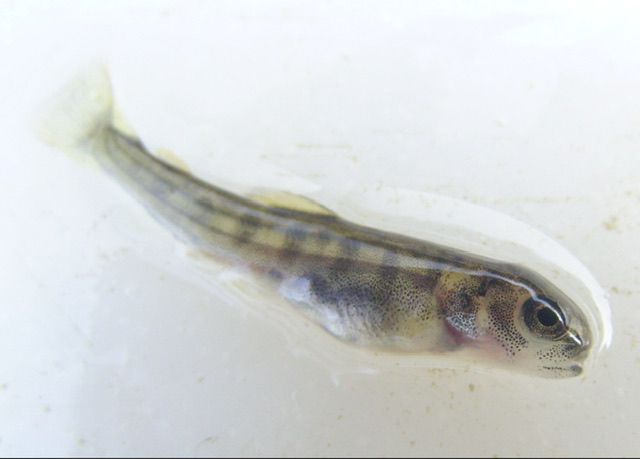
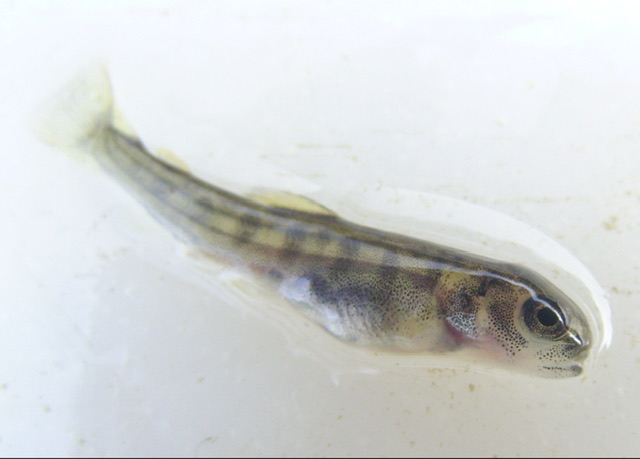
(A fresh hatchling with very little egg sac left, probably late leaving the box)
When they started to appear, you’d find them waiting in the catching box and then try to approximate the numbers while transferring to a bucket and take them to a sensible bit of stream to put them in. I tried to describe to the others, without sounding too ‘know-it-all’ perfect textbook fry habitat, and that putting them in deep or fast water wasn’t a going to work.
The biggest number appeared on a Saturday and the chairman collected what he estimated was around 3000, and took them to the 3-foot-deep water with no cover at all, at the end of his lawn, 10 yards above that sluice into the watermill and thus sacrificed the lot for his dream. There were few in the box the next day, so we assume he got down early and put even more in there. This rural Idyl to have Wild Trout at the bottom of the garden had overcome his sense of reason yet again.
There was rarely an easy conversation with the chairman and his rationale was often stunning. Replies arrived late in the evening, often we thought of and excused as Claret fuelled, were incredibly forthright, rude, and personal.
At one stage it was suggested reasonably that we needed to fence off where cattle got into the stream in three or four places, causing constant siltation. They made such a mess of the soft ground around and the water downstream was cloudy along way before it finally cleared of its burden.
One particularly bad patch was yards upstream from an area of gravel that the WTT had observed Trout redds activity. We could easily put automated drinkers up in the paddock, the farmers were keen on the idea, everyone on board and we could get a grant to finance the drinkers and the fencing.
It seemed the very definition of a no brainer!
Those late-night emails however flew furiously forth. Tales of his childhood in shorts and catching minnows in a little net from between the legs and swishing tails of cattle stood in these streams full of wild Trout. Of us wantonly trying to wreck the charm of the countryside, Vandals of tradition and he wouldn’t allow it “as long as he was responsible for the club”! (don’t even consider the thought of democracy here, he was in full blooded tyrannical rage).
It was of course utter fantasy, and that rural idyl that had wasted 3000 fry, again, was influencing our fishery management.
Those who received these rabid late-night rants would sigh and a silently shake our heads when we met up. There was nothing to say, and that silence said everything.
When my turn arrived, I was transfixed by those beautiful baby trout in the catching box but, I found that I struggled with my bucket of these hatchling fry to locate many suitable places to put them and realised that when faced with the responsibility of choice that there was actually a dearth of good fry habitat in those upper beats.
And there was no way I was going to put them down in the Nassington Road Bridge beat or in the Groynes!
I didn’t understand a great deal about the genetics in those days, ( still don’t) but I didn’t want those little prodigy of stock pond Trout, no matter how cute and adorable, no matter how paternally attached and protective I now felt after my winter of frozen fingers, mixing with our stream bred population. Not if I could help it.
The next winter we actually started stuffing old Christmas trees and loose bundles of brash down under the banks in suitable or vulnerable spots to protect from erosion or add some fry habitat to the upper beats where most members still fished.
As the fry hatch dried up after a few weeks or so, we calculated very roughly 10,000 had hatched, a 50% success rate. The box when cleared was heavily silted under that first layers of gravel, which got the blame for the 50 % failure.. So the following year we added a box full of brushes to trap the silt. And then part of the daily maintenance became empty the filter box and clean the filter brushes too.
Of those 10,000 hatched. Had this been in a stream with good fry habitat. Taking into account the terrible mortality rate faced in the first year you could assume 3.5% would survive to become parr marked yearlings .. That’s 350 parr and then 175 two year olds to be of breeding size in the model of a healthy habitat, which we most certainly were not.
But considering that 4,000+ had been dropped into the canal at the end of the chairman’s garden and were, to all intent and purpose, just wastage with no chance of survival. That I had put 1,500 in areas that wouldn’t realistically hold all those fish just out of desperation find fry habit when suddenly faced with the task. The Secretary put another 2000 in some good areas, but again too many for the habitat available. He had no options. The rest got unimaginatively dumped in the mill pool or in the nearest beat of fast deep water downstream with no fry habitat for 100’s of yards, and were probably lost to us.
So, 3,500 stood an outside chance that’s 122 max to make it to parr size and very optimistically just 61 two-year-olds from 20.000 eggs.
My personal feeling was that I’d be very surprised if more than a precious few got through and made it to some redds to breed.
So to sum it up.
Once a week from November through till late February Id missed a morning’s work, braving some freezing wet hands to help steer this through, and 5 likeminded others had driven here and given up time too. To then find a large proportion had been wasted on a vanity project for the chairman. It wasn’t great and a few dropped out. (So, I volunteered for two days the following year to nip his influence back a bit if possible, I also eventually put block on emails arriving from the chairman and the secretary, it wasn’t noticed and the ignorance was bliss).
But, as a project for a fishing club in transition, to my mind. This was a priceless exercise!
I set about describing Fry habitat to members and spending spare time creating some bits to install or plant. I found articles and descriptions to pass on, so the information was coming from other sources than just this club gobshite. People involved in the Egg box project or following it started looking for Fry habitat for next year or helping create it.
Those buckets of fry that people wasted in the wrong areas, were not squandered out of negligence or malice. They didn’t want to waste them. They just didn’t understand or couldn’t get the concept of fry habitat then.
But with a belief in the value of this project and a fascination, they gave up their time and invested it. They nurtured that hatchery box through the coldest bleakest days of winter. They shared that excitement of seeing those tiny, hatched fry. After all they had done all that they could, to help bring those tiny fish safely into this world, they then had carefully carried those fry and gently released them to the stream. Ony mostly in the wrong places.
Probably hoping to meet a few again in a few years’ time. When no doubt they would wonder if that Trout caught, was a fish they’d raised and released into the Brook themselves, and would thus feel a whole heap different about reaching for that priest and coldly snuffing out its chances.
More likely they would gently put it back into the stream and enjoy te sensation of watching it swim back to continue its mysterious life under the surface and grow on till the next encounter.
If we could get them looking for Fry habitat, considering the behaviour and needs of the fry. Then surely, they would start to understand how that differed from the juvenile and from adult habitat and develop some awareness of the balance or not, of the stream and recognise the bottle necks faced by this population.
I wondered that If we could get the main people who fished the brook actively invested in this, which usually seem to be a third of the membership, in the hatchery box and the hatchlings, and the habitat and switch the mind set from improving the fishing by managing the stocking, to improving the fishing by managing the habitat for the breeding fish.
Then in that was the outcome. I didn’t care if the hatchery box was a total 100% failure in terms of recruitment of breeding Trout and perversely I guess, in time I hoped it would fail in this aim.. Its value wasn’t in the fish it was in challenging and changing the values of the fishermen. It was a necessary step to get us where we are now, focused on the habitat.