Rickard Gustafsson | Saturday, 9 May 2026
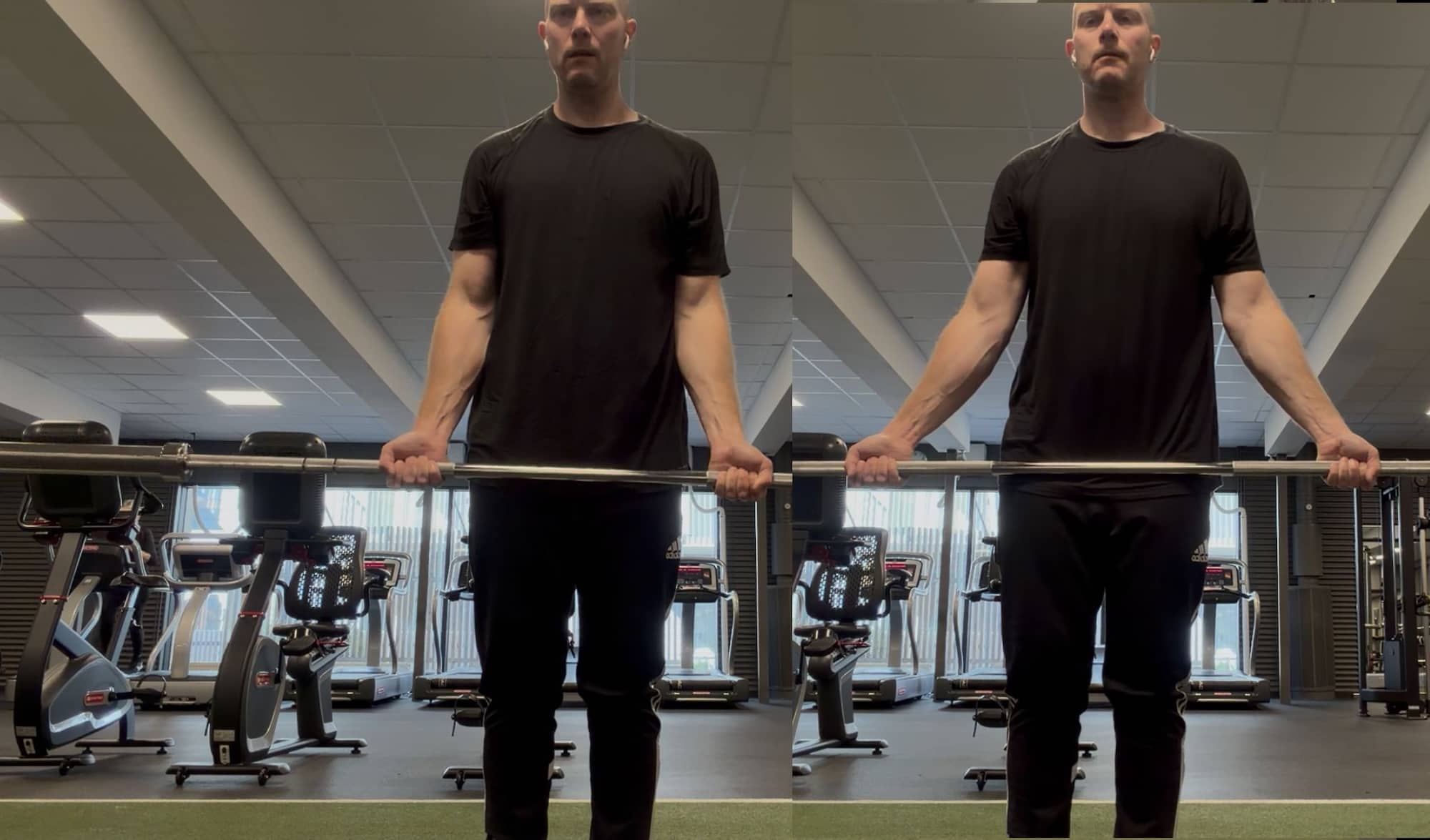
I’ve touched on the idea that the biceps has an important role for the fly caster. Now I’ve picked up some new ideas here. How to improve the training of the biceps. If you let your arms hang to the side and externally rotate your arms, let the palm of your hands point forward, your arms will angled out from the body. This is called the carrying angle. This is an angle we don’t spend much time in. Many of us spend a lot of time in the complete opposite angle as we spend a lot of time in front of a computer.
Having the arms by the side externally rotated in the “carrying position” is a good position to fully stretch the long head of the biceps muscle. This ties into the ability to rotate the forearm. And why do we want that? By restoring and having better movement in the chain we are less likely to get pain in the chain or help reduce pain if we have any. So this is something the fly caster wants to avoid or recover from pain in the arm from casting. And almost all casting we are doing we are working with the biceps in a shortened state so we are adding to the problem.
So how do we use this knowledge? We use it to modify or grip in some strength exercises. The barbell curl is a good place to implement this. Most of us probably grab the barbell with a close grip such that our hands are just right outside of our body in the bottom position. But if we instead grab the barbell with a grip that matches our carrying angle we are going to both fully stretch the biceps and strengthen the biceps in a position we usually miss. This is a tool for the toolbox to handle elbow pain.
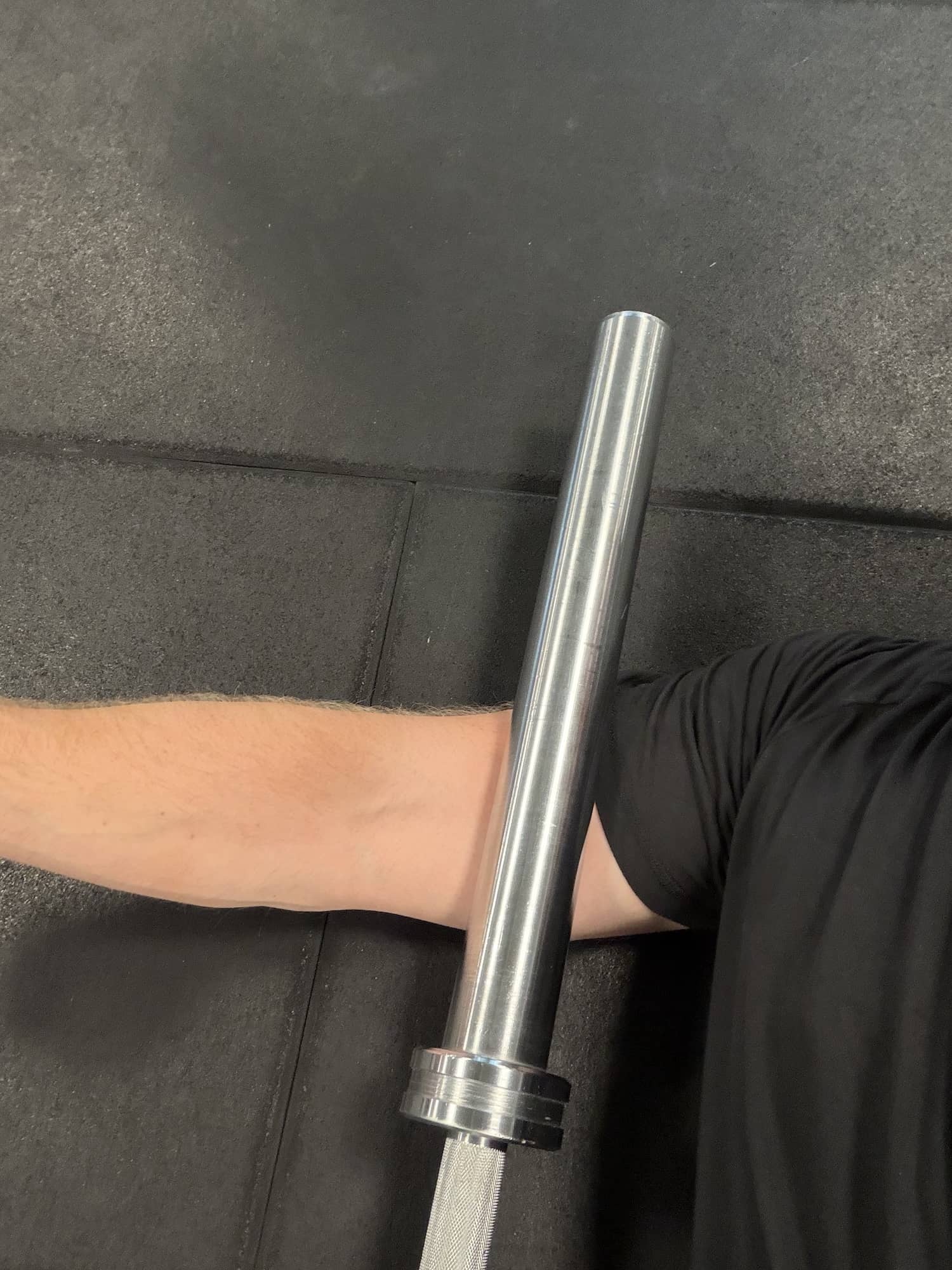
If we spend a lot of time doing accuracy training we might get pain in the elbow/forearm. Accuracy practice is the thing that has the highest risk for me now to get a flare up of my elbow/forearm pain. I have previously shown how we take care of the triceps to alleviate elbow/forearm pain. But the biceps muscle can also be part of the reason here. And stretching the biceps can help a bit but can also need some massage to get in a good state. And working a lot in a shortened state seems to make the biceps knot up a bit. I find that foam rolling the biceps can be a bit awkward and hard to hit the right spots. Massaging with a lacrosse ball isn’t easy either. Here I’ve found once again that the barbell can help us. By laying on the floor on the back and using the collar of the barbell we get at great tool for self massage. If we need more pressure we can also add that by putting or leg or foot on the barbell. Roll the collar back and forth and find the knots in the biceps. Spend some time just adding pressure when you find a knot. Rotate the hand and do some curl movements to restore movement in the knotted area.
Doing the self massage and the wide barbell curls you hopefully will have an arm that feels a lot better with less pain. Maybe not during the massage though.
An other area of your body that can need a bit of attention is the chest and front of shoulder. We can give this area a bit of attention while we are at the floor taking care of the biceps with the barbell. Just work the biceps all the way to the shoulder and when you reach the shoulder keep going a bit and massage the front of the shoulder. Up to the crease between the deltoid and the pectoral muscle is the area where I find the barbell a good massage tool. The pictorial muscle I find it to respond quite well to just stretching. Due to the layout of the muscle fibers in the pectoral muscle as a sun feather we want to stretch the muscle with the arm in multiple angles.
I also like to strengthen and work on flexibility at the same time. For me I have found out that press-up and bar dips seem to work better for this for me than dumbbell or barbell bench presses. And here I think the press-up is good progression to the bar dip. We want to focus on range of movement while keeping tension in the pectoral muscles. The initial goal here is to be able to do a press-up with the chest touching the floor. From there we want to increase the range of movement further. This can be achieved by stacking books or by using yoga blocks. Spend some time here doing controlled repetitions and stop before you break down in form for more reps and you will probably see that you progress quite quickly here. The good thing here is that you can easily do this at home so you can work on it frequently.
The bar dip has the advantage that we can get an even better stretch as we can alter the angle of the upper body also. In this exercise I recommend you to take it easy, spend a lot of time doing easy controlled repetitions and not stress progress. It is easy to put more stress on the front of the shoulder here than you realise and that won’t help your progress here.
Cheers, Rickard