Tracy&James | Wednesday, 5 August 2026
Many years ago, at the beginning of my career, I remember being in a technical meeting with some colleagues when one turned to me and whispered, with a cheeky grin, “if you want a straight line you should only make two measurements”. He was, of course, joking and it was more of a sarcastic comment on the quality of the data analysis that was being presented to us at the time by a scientist who should have known better. What brought this anecdote back to mind was some conversations regarding the scoring at the Game Fair competition a couple of weeks back.
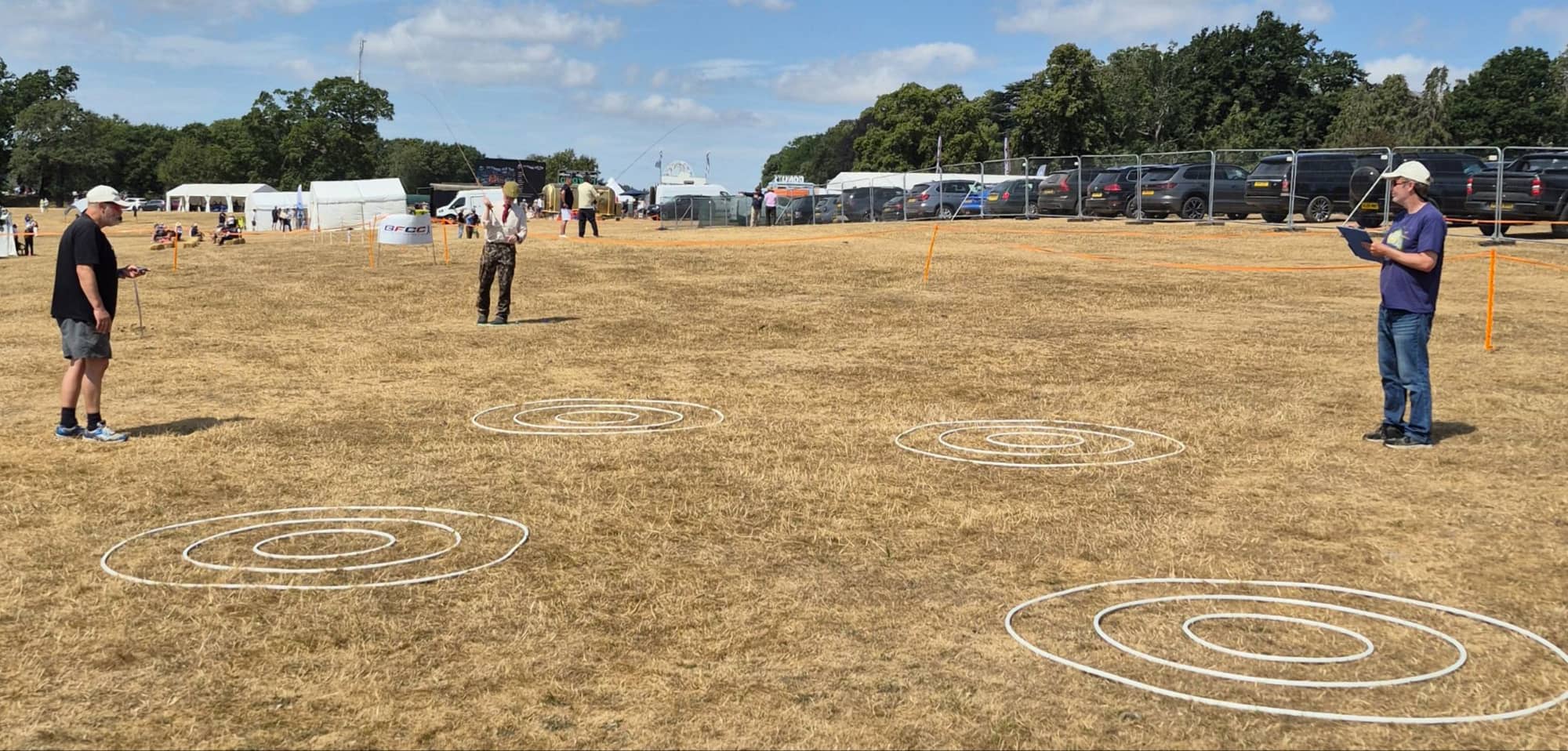
For those that don't know, some years back the BFCC were asked to run a championship fly casting competition that would comprise of three disciplines; single handed distance, accuracy and double handed distance. Unfortunately for the first year of this championship Tracy and I were unable to attend the final, thus this was decided by a set of rules chosen by the organiser who was there on the day. His version of the rules for the accuracy event were such that the maximum score achievable was unlimited and the caster just racked up points until their time ran out. He then just added this score to the two distance results in order to determine the winner. Obviously the winner was the caster who dominated the accuracy event, putting themselves so far in the lead that the distance events were pretty much irrelevant.
The next year, I insisted that the accuracy rules be changed to the world championship ones, with a maximum score of 80, and that the results in all three disciplines will be converted to percentages, so that each would contribute equally to the final total. This is exactly the same mechanism that is used at the BFCC to determine the overall event winner (across the seven outfits cast) and now in the world championships to determine the combined winners. I think this works well when there are enough distance events to counter the accuracy score, but the question was raised as to whether it was suitable for the Game Fair where there are only two distance competitions to claw back any deficit from the accuracy.
What I should say here is that I won the accuracy portion of the game fair, with a really good score (for me). Once put into percentage terms I had an advantage of nearly 19% over the next best score going into the trout and salmon distance. Meaning someone has to beat me by 10% in each – not impossible, but maybe a stretch too far given that I think the S55 is probably my best event these days. As a slight aside, the longest measurement rope the BFCC has for use on water is 60m long. This has never been an issue in the past as we've only had one caster hit that distance at the Game Fair since the BFCC have been running it. However, this time things were different and in contrast to the usually mid-summer hot, humid and still conditions, we had a strong wind that, if you were lucky within your allotted time, would align with the ropes. As such we had three casters 'max out' on the Salmon distance, including myself. So in essence someone had to beat me by 20% in the trout distance, equivalent to someone sticking it nearly 8 metres past me, and that isn't going to happen.
The conversations at the Game Fair revolved around the topic of closing up the results from the accuracy so that the difference didn't amount to something that couldn't be overturned in the distance disciplines. Looking at the results, there were four casters within 10% of the lead in trout distance and also four within 10% in the Salmon event (albeit a different four). In the accuracy there were three casters tightly grouped around the 80% with myself on 100%.
The first thing I looked at was making all the accuracy results ratio'd to the maximum of 80. This squeezed the results up by a fraction, but not much. The next thing I looked at was a simple linear function where 80 points maps onto 100%, but with a shallow enough gradient such that the difference between maybe 40 and 60 points is maybe 10% rather than 33.3%. The downside to this is that at zero points the caster would probably still be awarded with maybe 70%, and that doesn't sit right with me – i.e. someone who scores zero on the course, or doesn't bother competing, getting 70%.
I was then asked to look at how multi-discipline events are scored in athletics, e.g. the decathlon. I like watching the decathlon but I'd never investigated the scoring. It turns out that they use a multifactorial exponential function that rewards increased performance. This would actually make the Game Fair issue much worse, as we're looking to flatten out the percentages awarded rather than highlight a 'stand-out' result.
Ultimately I came to the conclusion that what would be required is the inverse of a exponential function. One that rises quickly from zero and saturates quickly around where the main bulk of the results are expected to sit, thus giving a somewhat artificial score but one that might make the Game Fair competition tighter should someone score way ahead of the others in accuracy again. Or we could just tell everyone to practice their accuracy and be better – what do you think?
Officially drought conditions here in Wales now, so probably won't be fishing for a while. I hope you have some water to fish where you are.
James.