Chris Avery | Sunday, 4 August 2024
Sunday morning and the wind was up, carrying some drops of rain occasionally onto the window pane, the day promised to go one way or the other, complete deluge or turn out fine. The ambiguous BBC weather forecast didn’t help to plan a day ahead. They might as well have predicted an intermittent covering of low uncertainty with the wind increasing or decreasing while swirling into every possible direction that you choose to face, with much more of everything returning as the afternoon progressed into the evening for an unsettled night a head. They hadn’t got a clue.
And being English I feel duty bound to mention this weather in the very first paragraph. Crucial as it is to my tale.
Taking a break from habitat work, I was planning on going down the field and attempt to work on some loops and carry. There was two ways at looking at this sort of weather for my casting practice; It was representative of true conditions that could be met and needed to be overcome if I wasn’t such a fine weather fisherman; or in the search for consistency and perfecting technique, it was likely to lead to frustration, bad habits and sap confidence and even set you back in your progress. Safer to have another coffee and croissant instead!
I decided to see how it would develop and get on top of some much needed house work, and just be a domestic goddess for the morning, top up the coffee machine and turn the radio up.
The previous weekend I’d got on top of the gravel clean up at last the best I could manage, and put the Brook to bed, ready for the Trout nuptials in a few weeks time.
The area that had distressed me most, where I had first seen Trout breeding, and where at times early on in my years on the Brook, I taken time off work and had gone down with a camera, tripod, a flask of tea and binoculars; to settle in for a few hours and observe the….um, ‘behaviour’ of the fish on the Redds.
Sort of Trout ‘Dogging’ I guess and not something you want to boast about in polite society, but we’re all friends here and you know it’s all done with purest of intentions and in the best possible taste. I wasn’t weird about it, though some of the local dog walkers appeared to find it an uncomfortably strange obsession and seemed to scuttle away quite quickly into the distance.
And I regretted now that I let the cat out of the bag about the specific area. That area I’d targeted being one of the main sites they had attacked with the Digger machine and seemed to have lost most of its gravel, but who’d have predicted that the club itself, would be so wantonly reckless?
When I did the survey of the lower part of the stream many weeks back with Bill the treasurer, I had purposely skipped past this area. I wanted to come back alone to concentrate without distraction and really explore around thoroughly, partly to fully understand the extent of the change here and see how it could be rectified, if in fact it could.
Mostly though from some misplaced nostalgia, that as in my mind and experiences, this was the hub, the breeding heart of the Brook, and that rectifying this area was the key, to getting the stream back in condition. Not terribly rational and a bit sentimental I am afraid, but I’m more artistic than scientist.
When I had gone down with a work party the weekend previous, this was the next area on the list before I sent them home for the day.. I didn’t want this area rushed and after they left I walked back up there to spend the dying hours of the day studying it. I took the afternoon off work the next day to continue exploring the area, in my own time, and considering the options. With a garden fork I started working over an area of stream bed about the size of half a tennis court, prodding, scraping, and poking trying to find remaining pockets of gravel. What was left was pretty uniform; a heavily compacted bed with a thin sporadic layer of fine stone embedded.
The meandering shape of the Brook and its banks entering this area was the same. The near bank was high with maybe a five foot drop down to the water surface, the far bank was lower a few feet at most as it tumbled down to the water level. And it was a tree lined bank with everything from small Ivy-laden Hawthorns and Elders, through to tall slender regrowth in the occasional gaps between massive Ash, Oak and Willows draped in Bramble and wild rose. Their canopies up 50 feet or more above the tiny stream on that bank, but on the near side with the footpath, it was clear, long grasses; a gap of some 80 feet between the nearby trees occasionally growing on this side of the water. The counter point of the wild unkept ‘Mother-nature-creeping-back’, and the cultivated agricultural land divided by the waters, was probably nowhere along this Brook, so well-illustrated as this short section.
Despite this open aspect there was no Ranunculus weed growing anywhere near.
But in the stream there was no longer the current gently switching back across to the mound of gravel bed and instead the current was concentrating on the near bank, under cutting it, eroding it, and delivering new soil, silt and stone into the Brook slowly during the year. And I guessed in larger packages it delivered this mixed blessing during the floods as it started to undercut the nearby path.
That productive gravel bed I’d studied the breeding on was now a silt bank building in the slacker water, that itself was creating as it stifled more current and grew in size. Looking at it I’d hoped the old gravel was still there, down under the silt. It wasn’t though, it was gone. And the water was mostly a uniform few feet deep across the whole area, featureless, and seemingly lifeless.
If I was to remodel this, I would need to stem that undercutting and find a way of bringing some current back into mid-stream. I left that afternoon wondering if the efforts and time needed would be worth it, and questioning if I could actually achieve any lasting change here?
Would my efforts be more profitable elsewhere? Maybe I should try and get the Wild Trout Trust back with the aim of getting more gravel shipped in to refill this area?
Maybe I should just get on top of my paper work at home and like other members of the club, leave this for someone else to deal with in future if they cared, or just let the stream flow how it desired, and see what it provided in a few years.?!
Come the next Saturday morning, after a week of noodling around in my head those problems and options remote from the stream. I’d rationalised a way through, and grabbed as many tools as I could imagine needing and more besides, determined not to be caught short; post drivers; 6 foot steel bar; tree saws; loppers; 1.6mm wires; pliers; sledge hammer; lump hammer; rebar pins; pick axe; heavy duty fork; rakes; ropes; chestnut stakes; coffee; and head phones. All needing shlepping from the car parked 80 yards away down to the work zone in a series of laden trudges that wore you out before you got started.
While I know it’s lovely and seems very worthy to have the sounds of the water and the song birds and the company of your own thoughts, but when working away like this I prefer the company of the BBC especially the music at weekend and even the soccer commentary if it’s my own beloved reds, or a documentary podcast to while away the hours.
Being a weekend though on part of the Brook with a public footpath on the bank. I’d have plenty of company from an enquiring public, here because of the love of the outdoors and somehow this little Brook had meandered its way into their routine also, usually due to the needs of little pooch.
So I was also to be the public relations face of the Fishing club and of Trout Fishermen and sadly needed to leave my grumpy git persona hanging at home on the hat stand.
In this section the public await or approach, armed with often the same or similar topic; Otters and our attitude towards them. Almost like a friendly challenge, expecting to find a conflicting view from their own. Not expecting it to be lighting the blue touch paper that will send me off on my wildlife observations, and how as a Trout Fishermen, and sometime river keeper, I find much benefit in sharing this waterway with lovely Otters and the Kingfishers. Gosh, I even love the Herons! There’s no conflict here with the Fly Fishing Club and their environmental wishes, we all swam together in the same pool of thought.
The only bones of contention left between us, are us catching Trout, even if we do put them back in. And, with me, my reservation about them letting their dogs enter the stream several times along the walk. “Little pooch can’t do any harm and he needs to cool off”. It’s so hard to get them to see sense.
I wish they could consider how many little pooch’s pass this way each week , entering the stream in the same places, eroding the banks, silting up the areas where they’ve warn out vegetation. There little claws and paws pumping away as they swim to get sticks and stones, ripping through the Ranunculus weed and dislodging it, making areas of water bereft of life and over time these patches increase in size. Little pooch is a bigger nuisance now than cattle to us, and seem harder to stop. I’ll see twenty dogs in a weekend maybe, let’s be kind and say 25 per week, 100 a month, 1,200 a year averaging 3 dips. 3,600 events of running in and out of the water in mostly the same places, just in that ½ mile section. The scouring of the banks just gets deeper and it never gets a rest period to recover. Come the winter floods those are the areas of weakness without vegetation that the currents can worry into and further erode.
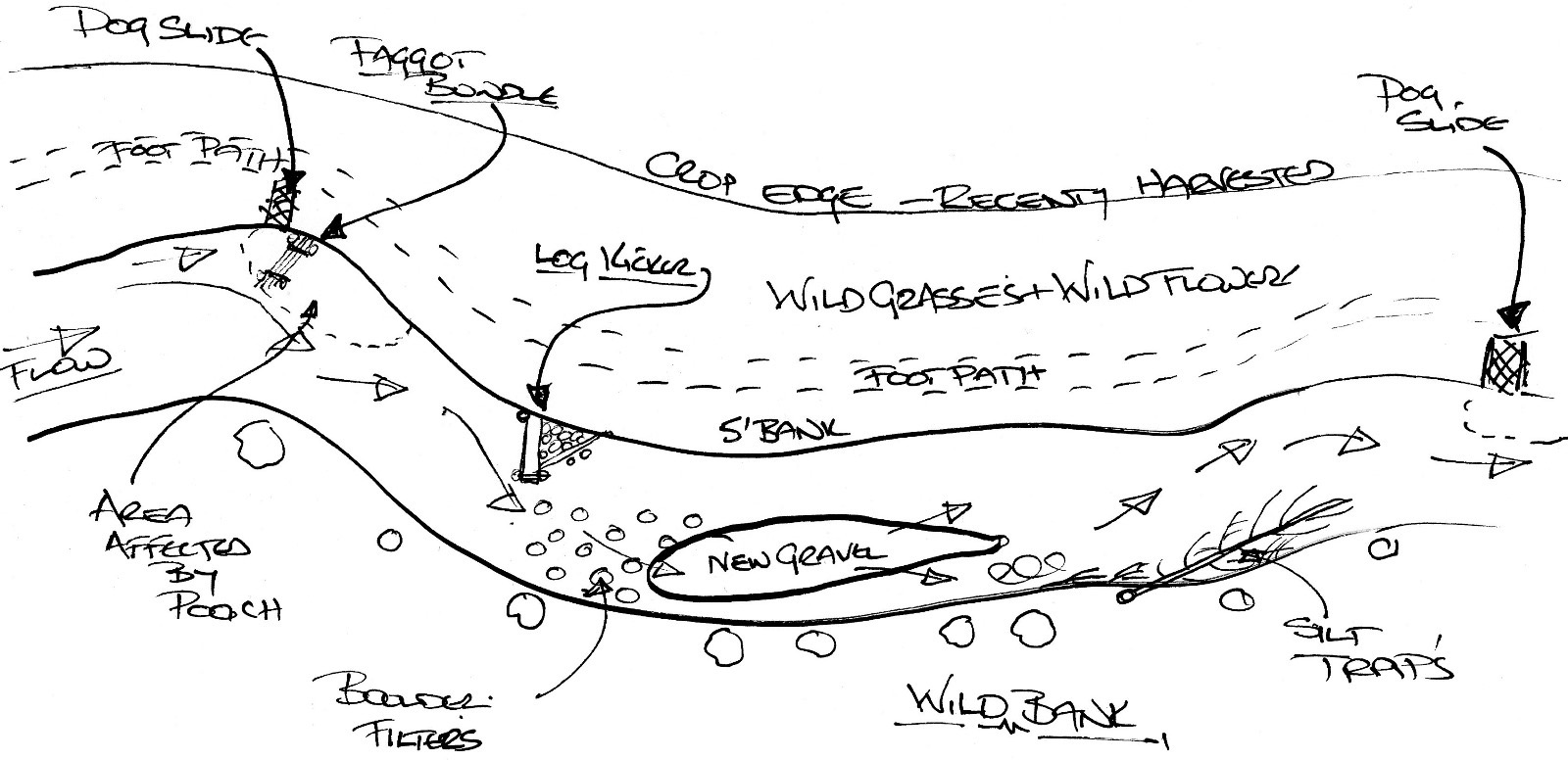
Stood on the bankside early that Saturday morning, considering the plan of action, without being a flowing stream myself I only had the imagination to put it back as I remembered as best as I could, and the first job was that undercut bank and that flow creating it. I managed to find enough wood to be tied up into a decent sized faggot, flow deflector, and as a bonus, an off-cut of an old log some 6 – 8’ long that had drifted down stream. With a rope I could drag it sled like along the footpath 50 yards up stream to then tumble it down the bank to some waiting Sweet Chestnut posts I’d struggled to drive deep into the bed, ready to hold this new current kicker steady while I wired it to the post.
Thankfully I was up on the bank when it hit the water with a huge splash just on the right side of the posts, with helpers on hand I would have been soaked , and there was no need to wrestle it back upstream, it sat in place waiting. The posts were the right distance and it was easy to wire on with the current holding it in place, things had started so smoothly and a self-satisfied smugness crept in…. always fatal!
It was wrong, I got the angle wrong. I was missing the target area with the deflected current where it was coming off the kicker. And then had to find nearby ground in the stream bed that would let me drive two more posts in just upstream to make the angle less acute, that’s an hour of my day lost and a lot of energy operating a two man post driver single handed. “I could do without this.” Whatever music was playing in the back ground it should have been blues on the radio, as I felt like I was working a miserable Mississippi chain gang, lifting and driving down that post driver to a juddering, noisy halt, the posts barely moving down with each blister lifting impact through my hands. The fact I’d got it wrong made it feel even more futile and onerous.
Releasing the wires and wrestling the log against the current and onto the new posts, the effect was immediately evident, the current switching across stream to where the main gravel bed used to be, and I could see that silt mound starting to colour the stream. The effect however was now too strong and too targeted. Left like this, any new gravels would likely be swept away.
Further up-stream, around the bend I drove in stakes ready for the faggot bundle, hoping to take the velocity off the kicker and filter out the force of water across the streams width.
Cutting out all the longer wispy materials and saving to one side. I took the stronger stems and wired them together on the bankside into a tightly bound thick faggot of hardwood branches about 6 feet long. The remaining finer stems were loosely bound at one end, into long fan shaped bundles. I managed three good ones from the left overs and found a few long wispy branches of twigs around 12 -15 feet long to add to the collection.
After the faggot was wired into position it was a case of a little patience, watching the current and how I had adjusted it. In a small Brook like this the only real way is to let it settle, aimlessly staring into the water during the time it takes to sip a cup of coffee, out of the stream where your legs aren’t adding to the confusion of currents, and slowly the new narrative of the flows appear.
Fortunately, the really high bank of this section gave me a good aerial view. The velocity off the log kicker was now a little kinder, as was the water gently passing over that log and dipping down towards the river bed, no longer scouring out a hollow behind.
That silt was going to be moved off and I wanted to trap it into the bankside and squeeze the flow in, keep it moving, to help sort the stone in the stream and excavate the channel through here a little deeper over time, that would be a job for the stream itself with a little nudge from me .
The flow hitting the silt was dissipating along the bankside 10 or 12’ downstream, so I chose there to place most of my fan shaped bundles, wired to posts and fixed to the existing bankside tree trunks, these would serve a multitude of purposes. Slowing down the current further; trapping the silt in suspension of the slower waters created in the confusion of twigs and stems; building up a new base of the stream, making the stream shallower here; and with the many stems spiking up out of the water; creating cover and privacy for any of those hatchlings from the spawning grounds as they moved down the bank looking for shelter.
Not satisfied that I’d done enough, I selected one of the trees on the bank, a tall sapling really some 15 feet high with a stem about 4 inches in diameter and cut it off. I wired the trunk into the old stump, resting the young tree down onto the silt traps, compressing them a little. At water level now it all looked like a pleasing little jungle thicket, completely natural and like it had grown that way.
Back on the near bank I had enough time of the day left to play with those posts that had been driven in earlier in the wrong place. Finding some more branches to supplement what I had left I fixed them from the end of the newly secured kicker back to these posts creating an open triangle to the bankside.
Any water sliding over that log would trip down into this, with added brash or stone, I hoped the silt and fines in the current would be trapped and this eventually would get bankside vegetation or marginal plants like Irises inhabiting this area, binding it together with the roots and rhizomes. I was already planning on speeding up the process with some gorilla gardening and wondering where I could liberate some native flag Irises for the cause.
I started dropping the remaining branches and twigs in while tidying the banks from my debris. The effect was pathetic frankly, it takes a lot of material to fill one of these.
Close by across the foot path on the verge of the farmers harvested field was sporadically scattered larger rocks and pebbles brought up by the plough and worked to the edge of the field. I laboured away into the dusk for the best part of an hour gathering up armfuls and dropping them down into the triangle and squashing down the woody material flat. It’s strangely addictive and hard to stop. I found myself further out in the field finding new pockets of stone and although I was sure I was doing no harm to the field. “A wheel barrow a wheel barrow, my kingdom for a wheel barrow” thought I, a few hundred yards from the birth place of that hunch backed king.
In fact, though I was actually helping out the farmer by doing this. It did feel a little clandestine though and I prayed I was out of view of the distant farm house elevated above the valley. “Why’s a bloody fishermen walking across my field… Is that Avery?”I could imagine him bellowing to the missus.
By home time, it was two third full of rocks, of dense iron stone pebbles, or of flat limestone walling rocks mostly the size of mangos up to small melons. I could no longer see it in the dusk, it was just a black triangle by the stream bank, but that was now going to be a permanent feature. The place was a little better for my efforts today.
The next day it was pleasing to see what I had managed, I’d got on better than I remembered now, in the clear light of day, but the effects and results of the remodelling needed to be imagined still, there was little to see in evidence, slightly less silt on the pile and some signs of scouring on the beds with the new flow showing up some rocks and gravel.
I waded over to the far bank and looked at the area around where I wanted the gravel bed, and did a rough measurement of the flow rate , it was somewhere between good and too fast, I needed to bring it down a little slower but I didn’t want to change the direction of the kickers again. There was no way I was going back on that chain gang again today!
From the farmer’s field yesterday I’d found some bigger boulders that had been tossed in the triangle and were still exposed. There was a number them around in the stream also both up and down of the target area. I was hatching a plan on the hoof.
I started off upstream of the top bundle, forking up the surface across the stream to loosen up the surface gravel. As an occasional break from the tedium I’d go back to the silt pile and with a fork or rake loosen up the top and release it for the stream to wash away a layer, clouding up everything downstream for a while. By the time I had it flat to the bed, I knew there were no gravels remaining, presumed robbed by that mechanical bucket.
After many conversations with strangers, hot drinks, hours of music and sandwiches, big sighs, soakings and splinters later, I’d loosened up the whole surface of the streambed and got rid of that pile of silt and I was knackered; bushed; rooted, done in! I’d also fossicked together a group of a dozen or more large boulders slightly bigger than soccer balls to finish the area off.
From those Chestnut Stakes I’d driven in. I had some long off cuts spare, I used the bar and where I was intending to set the gravel bed, I opened up four deep slender holes to knock down and bed the posts into, driving them down deep into the stream bed, just sticking up 4- 6 inches and linked them together with some wire.
I had no idea if it would work. I’d never tried it before, but I hoped it would stabilise the new gravels a little.
The rest of the afternoon was spent with a rake pulling stones over from all around, dragging them up to these off cuts gradually burying them in gravel. Treading each layer down and tamping it into place with the rake. I mounded up the front steeply, where the stream would hit it and then gradually dropped it away with a gentle slope, to meet the stream bed.
I then raked up some extra of these precious and increasingly hard to find stones and filled the area between my new spawning ground and the far bank for the passage of the hatchlings to wriggle under the gravels from the redds to the bankside before entering the waters . The new pile was around 6’ wide and about 15 feet long in all, with an area of 5-6’ square that was usable deep redd… if its stayed put!
Then for the final touch I got to work on the small boulders. I started using them to direct and filter the flow hitting the front face of the bed, spacing each about a yard apart gradually upstream. No doubt the winter floods would tumble most of these, but in a couple of weeks when the fish are on the redds they should be functioning, and any that survives the winter will become good mid-stream cover for Trout on the feed. Hopefully by then some grit and fines will have swept into some of the spaces and help stabilise the pile.
3 days of work and now all I could do was tidy up before it got too dark, tossed the remaining materials in the triangle and cover it with a few more rocks, trudge that pile of tools back to the car, cursing life for not providing disposable post drivers and 6 foot iron bars. And then wait less than a month now, for the Trout.
3 days of labour and I had produced 1 potential spawning ground of about 5’ square, a load of good fry habitat and saved a bank from erosion. It was a satisfying feeling looking down on it from the high bankside, you’d hardly notice I’d been in there and done anything, my body though, told a different tale and a hot bath beckoned.
I don’t think I’d invested so much time and effort on one little project before in the Brook, those bloody fish had better use it.
So on a wet Sunday morning a week later, Chris was doing the house work while the rain pattered on the window pane…. to be continued.
Happy Sunday y’all. Hope all’s good in your world. Tight lines and dry waders and have a great week ahead.
Chris Avery