|
Hi Sexylooper,
And welcome to Snapcast November 2007! The best
and most irregular flyfishing mailout going. This issue
sees a bunch of new content, much of which has
come from Sexyloops' Board Members including a
great article for Grunde and Jason Borger. There's
reviews, articles and some other fishy stuff. It's very
exciting, quite dramatic and *hopefully* I'll be able to
figure out the page formatting well enough for you to
be able to read it.
It's been a fantastic summer here at Sexyloops.
I've personally been all over the place since our last
Snapcast, from NZ to UK to Hungary to Canada
(where I fished with Eric and Bob) back to Hungary,
Serbia, Austria, Croatia and Bosnia. Busy making new
flyfishing friends and inviting them into our loop as
well as finding out how they do it where they are.
Here at Sexyloops it's all happening, all the time,
even when it's not.
Cheers, Paul
| Nymph Fly-Tying Techniques by Jim Schollmeyer reviewed by Jo Meder |
 |
|
Jo Meder, based in NZ, emailed me offering to write
up some book reviews. I'm like, "sure, ok, if it's good
enough". What I didn't expect was a thoroughly
comprehensive and well written review, which just
goes to show something - but what that is exactly I
have absolutely no idea...
I ordered Nymph Fly-Tying Techniques only
because it mentioned a few things in the contents that
I was interested in, and hadn't seen covered in other
places I'd looked. I wasn't really expecting to get too
much more out of it than that, but it was pretty
inexpensive so I didn't mind. What I got was a book
absolutely chock full of useful
information.
Nymph Fly-Tying Techniques
won't tell you how to wind a dry style hackle, tie a
parachute hackle or up-wings. It also doesn't cover
tube flies or articulated flies. Emergers aren't really
touched on. Apart from that, it really is a
comprehensive manual of fly tying techniques.
|
| Sexyloops Clothing by Ron |
|
|
Here's a message from one of our sponsors...
Yeah, g'day, Sexyloopers and thanks Brother Paul
for
allowing me this fantastic opportunity to say a few
words to your most-excellent readers.
Dudes, don't buy wool. You don't need it and I do.
Instead buy something great for the environment:
Sexyloops Fleecewear. It's made from recycled plastic
bottles and not sheep. So do yourselves, the planet
and me a favour and buy some today. You know it
makes sense.
|
| Intermission |
|
|
Thinking about where to go next for a flyfishing
adventure? Considering a casting lesson? Looking
for some new tackle?
It's ALL in our Directory!
|
| The Fat Boy by Morsie |
|
|
An article by one of our bearded Imaginary Saltwater
Flyfishing Gurus. As well as a comprehensive flytying
sequence this article also features an angler fishing
in what can only be his pyjamas.
Fly tying is an illusionary skill; we're out to create an
illusion of life. But illusion can extend beyond just the
appearance of life in a fly. The fly pattern demonstrated
here has become a great favourite and is a perfect
example of creating the illusion of bulk without actually
having weight to match that bulk.
Fly tyers and fly fishers need to take notice of the
shape
of baitfish and look to re-create the profiles we find in
nature, as well as the details of shade and colouring.
Baitfish come in three fundamental shapes; the broad
flat profile of a sardine or herring; the fat round shape
of a hardyhead, small mackerel, pilchard, garfish, or
mullet; and the slender profile of an anchovy. Fine
tuning
details such as colour, flash, movement, eyes and red
gill flashes all keep us, the tyers and the fly fishers,
happy and confident. This state of happiness should
not to be underestimated, but the silhouette a fly casts
should not be neglected either. Most predators strike
from below and this highlights the fly against a bright
sky. This silhouetting effect results in shape having far
more prominence than individual detail.
|
| Scientific Anglers Mastery Tarpon Intermediate tested by Bob Wyatt |
|
|
OK they're obviously not as good as RIO, because
after all RIO advertise with us and SA don't (because
we're too sexy), but that doesn't prevent us from
running reviews - after all most of us here at
Sexyloops are angels in disguise - Magnus for
example, he's wearing one hell of a disguise.
I was nowhere within a thousand miles of anything
remotely like a tarpon, and the Australian 'baby' tarpon
aren't really what this line was designed for anyway,
but for the work I was doing it seemed like the
ideal ''heavy' flats line. I was up to my belt buckle in
saltwater and working hard to punch a 1/0 Clouser
into a stiff 25 knot southerly. The amazing thing to me
was that it was working.
|
| Spey to Z - Understanding Traditional, Scandinavian and Skagit Style Speycasting with a single and double handed flyrod. Reviewed by Viking Lars |
|
|
Phew, this is taking some time. I wonder how it looks
so far? Anyway here we have an article from Lars on
Way Yin's casting video. Way moderates our DH forum
of course, so Lars wasn't allowed to write any bad
shit.
Anyway, you can buy this GREAT! video from
Sexyloops, and if you're lucky/unlucky you may even
receive a signed copy. You can buy your copy H
ERE in our store.
Way Yin kicks off the movie with a chapter on what
flycasting really is - tight loops/wide loops, tailing
loops, appropriate application of power, SLP, timing,
casting plane, acceleration, hauling, stroke and more
are explained in a simple and clear way!
Way then moves on to explain the transition from
overhead to speycasting, putting strong emphasis that
the same mechanics still govern the cast and that the
principles for speycasting and overheadcasting are
the same. Moving onto the anchor, the importance of
the 180 degree principle is emphasized.All through
the movie, these principles are in focus, and I feel that
the movie gives a very good understanding of the
differences between Spey casting, Underhand casting
and Skagit casting, and maybe even more, gives an
even better understanding of the similarities
betweeen the different casts.
|
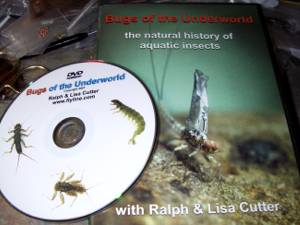
| Bugs of the Underworld by Ralph and Lisa Cutter. Reviewed by Eric the Rock |
|
|
For quite a few years I lived with a bug tank in my
bedroom. I've watched buzzers hatch, studied the
hectic lives of corixae and stared for hours at the
home-building caddis. A fascinating underworld. Here
Eric reviews a revealing video...
From below the mirror an angler passes. His
wading boots slosh by ignorant of the world beneath
the water. Bugs swim and crawl fighting the currents
going about their lives far removed from that of the
land mammals toting their fly rods who so rely upon
these tiny insects.
This latest release by Ralph and Lisa is short and
sweet. The underwater video is clear and sharp and
wholly focused on exposing the aquatic and elegant
lives of the Bugs of the Underworld. In Ralph's words,
it's about "Benthic Macro Invertibrates. They live in
water. They're big enough to see with the naked eye,
and they have no backbone. BMI's for short; I'll just call
them bugs."
|
| Matt's Corner |
|
|
If you haven't checked out Matt's Corner in a while, do
so! He's been busy and has even nailed a few
Steelhead. His string leeches are awesome and his
legs are hairy.
|
| Fish of the Month |
|
|
Fish of the Month was in fact this Asp that Paul caught.
So well done Paul!
|
| The Snapcast by Paul Arden |
|
|
Now you may be wondering about the history of the
Snapcast and why we've chosen to give our
Newsletter this name. Well here is why:
The name "Snapcast" comes I believe from Jason
Borger, who's good at naming stuff. The cast itself is
older. Claims to have invented it come from Austria,
but these are refuted by casting clubs in the States,
not that it actually matters, because the Aerial
Snapcast, which is far sexier, was invented by me. Of
course someone else may have invented that one too,
you know, before me - but they forgot to tell anyone.
Me, I've been telling everyone about it and in particular
one version which I call "The 69" - because that's both
how it looks and feels. (The original 69, by the way,
was invented in Austria - and by two nuns in a
Yodelling competition - they were French
however).
The physics behind the Snapcast is quite interesting
and was figured out on the Board by our engineers,
with assistance by Newton. The flyline mass is
moved, giving it momentum, a Snap is duly performed
which has the effect of removing a large amount of
mass from this moving line, the remaining line
accelerates due, mainly, to the removal of this large
amount of mass and the Momentum Conservation
Principle is applied. If it was to happen in a Vaccuum
the caster would die - obviously.
Back in the days before I knew Jason, and had thrown
snowballs at him, I'd called the Snapcast
the "Flickcast" and you can learn about it here in the Manual.
And then in Jan 1976, following a gruelling sex
session with two lesbian firefighters, I took my flyrod
out into the deep snow. Inspired by the antics of the
last sixteen hours I started playing with different Snap
applications, and then a Thunderbolt of Lightning
struck down from Heaven (it was Sunday) and the
Aerial Snapcast was born. And from that point onward,
flyfishermen everywhere have Iearned to
Strut.
And that's why we call our newsletter "Snapcast".
|
| In the next Snapcast |
|
|
I have
absolutely no idea - but it's going to be great.
We're considering launching the long-
awaited "Flycasting for Nuns" section as well as of
course an interview of The Queen Mother by Six-pound
Sean in a jacuzzi. Worth tuning in for that one. That's
all for this issue!
Cheers
Brother Paul
|
|
The Rod & The Cast by Grunde Løvoll and Jason Borger |
|
|
|
Ground-breaking stuff here from Grunde and Jason.
For years we've been arguing both about the rod
spring vs leverage as well as the 'abrupt/hard stop'.
Well finally we're starting to figure it out and Grunde
and Jason really put the pike amonst the pigeons
with this
article....
Two of the subtleties that have been of interest to
fly casters are the "stop" at the end of the cast and the
contribution of rod "spring energy" to the cast. Those
two aspects of the cast are the basis for this article.
To gather the needed data, four forward casts
made by two well-known Norwegian casters were
recorded using a 500 frame-per-second (fps) video
system. The rods and line had visual markers, which
enabled us to follow the motion of rod and line in time
and space. ImageJ and MATLAB software packages
were used to do the tracking and number crunching.
Each caster made two casts with a Sage TCR and two
casts with a T&T Paradigm (both nine-feet long and
rated as "five-weights"). Additional, supporting data
was gathered in the U.S. using a 200 fps, three-
dimensional motion-capture system (with Borger
serving as the caster, using a Sage XP and an Orvis
Zero-G Tip Flex rod, both nine-feet long and rated as
a "five-weights"). All of the casting was performed
indoors to eliminate environmental factors such as
wind.
Read on...
|
Sexyloops Sponsors


|