Español
Manual de Lanzado
Sección de Carlos
The Downloads
Falsecast
Monday: Paul Arden
Tuesday: Harps
Wednesday: Bernd Ziesche
Thursday: Mr T.
Friday: Sudesh Pursad
Saturday: Viking Lars
Sunday: Akos
|
|
Español
Manual de Lanzado Falsecast
Monday: Paul Arden
Monday 20th May, 2013
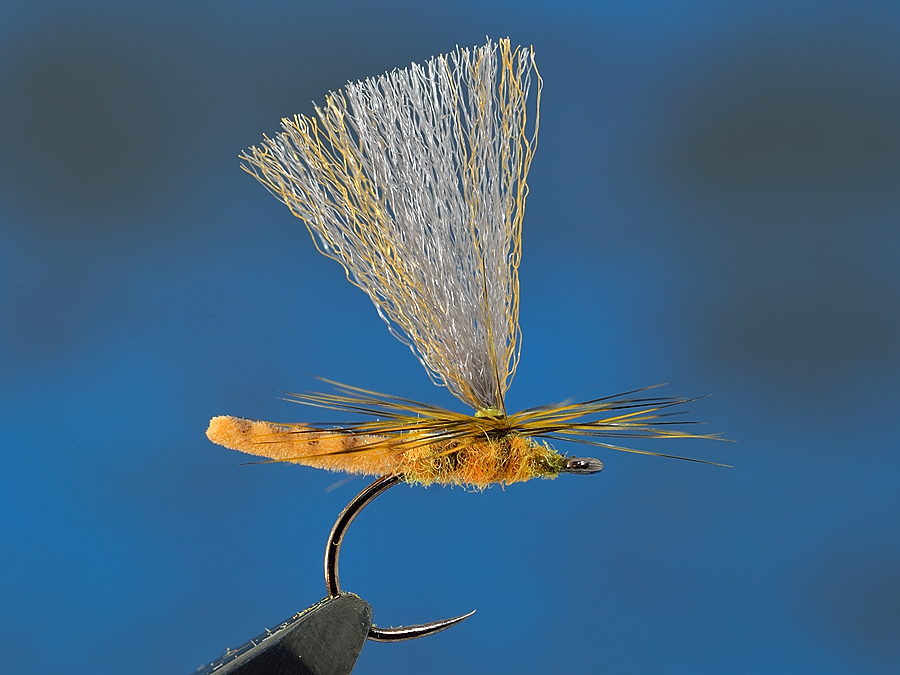
I'm going to pick up on a topic that Bernd wrote about sometime ago, mainly "How to design a great fly". It's a topic which many of you will think I know absolutely nothing about, and there is a great deal of truth in this, because I believe that it's the fish that design great flies, or if they don't actually design them - because how, or indeed why, would they do that? - then they are responsible for the continual tweaks that we make. All flies I believe are works in progress and it's only after a very long time, and many fish, do they become somewhat stable. I also think our background roots in flyfishing have a great deal of influence on how are flies look. Mine was stillwater trout fishing, as virtually everyone knows. I was extremely active in the mid-late 80s when stillwater dry fly started to evolve in the UK. Back then no one I knew fished dries apart from a few regulars who occasionally fished dry sedges. What was waiting to unfold was pretty much a revolution. I started fishing dries because of my mother! She had visited a tackle shop while on holiday, and presented me with some river dry flies and a can of spray floatant. I was given these in September - they didn't float very well - but they caught a hell of a lot of fish, and moved a hell of a lot more, and I couldn't wait to try them the following year. This was at a time when almost everyone stripped lures for trout, the occasional wet fly and there were a few switched-on guys who were fishing buzzers. It was the next year that I discovered Gink. I'd never seen it before and as far as I know it was new in the UK. Gink changed my life - and everyone else I knew too, so much so that Gink became a verb - to gink, ginking, ginked! I started using damp flies; a Hare's Ear picked out and I had a fly similar to a picked-out Amber Nymph which I could gink too. I also had Skues' Little Red Sedge and I was nailing fish on dries! It was around then I met a chap called Dennis who fished for Grafham, he was fishing dries too, and remains to this day one of the best anglers I've fished with. Dennis actually tied the first Hopper - a shortened up Daddy Long Legs with an orange body, had some interesting experiments going on and brought dry fly to the competition scene and from there it became known. The Shipman's came out soon after and that was a far better fly than the Amber Nymph/Dry that I was fishing and I started tying suspenders too, or maybe I was doing this before, anyway I've jumped topic... So back to the subject! I think a great fish catching fly works for many reasons, the first is it can suggest the life that the fish is eating, which normally means no hard outlines. Imagine the difference between a doll and a human. If I was to present you with a smudge that looks humanish it would be difficult to determine if it was a doll or real. So smudges are good. A fly that has inbuilt mobility has to be good. It will work for us, just by sitting there. Seal's fur, soft (hen) hackles, rabbit are good examples of great materials that will move and catch fish even when we're not pulling them. Colour is a huge trigger. You can indeed present just a colour - orange for example - and it will catch fish and can be the only answer. Sometimes the colour to fish is not the colour of the naturals. In small flies, I think claret is better than olive for example, certainly when it comes to buzzers. But mixing colours is the best. I try never to use one shade of olive for example, but instead mix two or three different shades. Fish prefer this. Which makes sense when you think of hard outlines. One shade of a colour is the equivalent of a hard outline. So that's my philosophy, don't try to imitate the natural, try to suggest life by presenting a smudge. Oh, there's more: A great fly should take between 60 and 120 seconds to tie. There are very few flies I fish that take significantly longer than this. Muddlers (Minnow), Invictas, some nymphs, the RFU and Terminator style flies do take longer - hell I often have flytying competitions with mates, where we tie flies that take literally hours to tie - but the best flies in my opinion should be quick. Ten in twenty minutes would be normal for my best flies. So we're talking a fast colourful smudge. Perfect! Today's POD links to Operation Fluff, the experimental members' section from nine years ago. There are 100 great flies in there! Cheers, |
|
Sexyloops Week:
THE SEXYLOOPS HOT TORPEDO - Available Here. It's taken more than eighteen months from conception to production, numerous prototypes and experiments, two explosions (!) and many rebuilds and finally we have an outstanding flyrod. There are some truly exceptional rods available, in the high end of the market, so the benchmark is high and there is no question that we want to try raise that standard. That has been a very tall order - but a great rod is built first on a great blank. I look for several things in a blank. It has to be fishably fast (maybe someday we'll produce a slower rod, but not for me!). It has to have feel; flex for short range accurate casts, with feeling, and yet it has to have action that allows it to flex deeply for long range casts too. There must be smooth progression between these two elements. Finally I have no compromise with regards tip stability, if the tip wobbles or bounces putting a series of waves along the fly leg of the loop then I am not interested. The Hot Torpedo has the best tip recovery of any 6-weight I have cast. I've been working with Alejandro in Spain who is a tremendously experienced rod designer and one of the finest and most knowledgeable flycasters in the world, to produce an exclusive Sexyloops' rod that we can launch upon the market. Our blanks are carefully manufactured in Spain using four different types of high-grade carbon to our own exclusive design. These blanks are then transported to Hungary and built by Gampi, a massively experienced rod builder who gives supreme attention to the smallest details. We fit the very best cork handles to an exclusive Spanish design (maybe living next to Portugal gives them access to the finest cork, I don't know, but I do know these are the best production handles on the planet). We use Hopkins and Holloway Single Legs on the Competition 5 and Instructor 6 rods, and Single Leg Recoils on the Pro 6 rod. Our logos have been designed by Al Pyko. Our reel seats are manufactured and anodised for us in Hungary. Our rod tubes are (currently) manufactured in the USA. My white prototype Instructor rod has been in literally hundreds of casters hands, some of the best distance casters on the planet have thrown it. The feedback has been outstanding and despite six months of incredible abuse there are no ferrule cracks, and believe me, this is very important! Stefan broke one of our prototypes in Scotland in May. The rod went straight back to Spain, with the idea that the broken section should be strengthened around the ferrule. Alejandro's response and action was to strengthen the entire second section. Something that actually went to further improve the action of the rod! When Mr Hardy first built his company he did so on an idea that nothing was too good for a fly fisherman. That's my philosophy too. You have my word that we will never compromise over performance. We are working on several line weights and currently we have one blank ready for release. With that one blank, we have the Competition 5, the Pro 6 and the white Instructor 6. We have no planned release dates for other products - we are working on many! - they will simply be released when they are right. The Sexyloops Hot Torpedo... Fly Fishing Without Compromise To assist me, I have a full-time Retail Manager, Akos Szmutni, who has been busy working on rod production for me in Hungary, as well as filming and editing our soon-to-be-released Flycasting mobile phone App (three hours of downloadable flycasting instruction video, which has taken most of the summer to prepare!). Akos has been working for me full-time for the last two months. I also have a part-time Assistant Marketing Manager, Djordje Andjelkovic. Djordje is a new addition to the fold. Welcome Djordje! Cheers, Paul SEXYLOOPS SCHOOLS Flycasting and Barbel fishing in Spain. Contact Carlos for more information. Flycasting in England and Hungary. Contact Paul for more info. Sexyloops on Facebook: www.facebook.com/Sexyloops. Sexyloops on YouTube: www.YouTube/SexyloopsTV. This is Snapcast - our irregular monthly mailshot! |
|
www.sexyloops.com
Copyright © 1998-2013 |